Aave (AAVE)
Overview
Aave is the largest decentralized lending protocol in DeFi. Users deposit crypto assets to earn interest, while borrowers use collateral to take out loans. The protocol operates in a non-custodial, permissionless manner and is deployed across 12+ blockchain networks. Aave controls approximately 40-45% of the total DeFi lending TVL, making it the dominant force in on-chain lending.
Originally launched as ETHLend in 2017, the protocol rebranded to Aave (Finnish for "ghost") and pioneered innovations such as flash loans and variable/stable interest rate switching. Aave has surpassed $71 trillion in cumulative deposits and $1 trillion in cumulative loans over its lifetime. The GHO stablecoin, launched in 2023, adds revenue diversification beyond lending fees.
Primary Use Cases
- Lending & Borrowing: Deposit crypto to earn yield or borrow against collateral at variable or stable rates
- Flash Loans: Uncollateralized single-block loans used for arbitrage, liquidations, and collateral swaps
- GHO Stablecoin: Overcollateralized stablecoin minted against Aave deposits, generating additional protocol revenue
- Institutional DeFi: Aave Arc provides permissioned lending pools for regulated institutions
TVL & Revenue: Aave holds ~$14.0B net TVL as of 2026-07-21 (DefiLlama), down from $17.3B on 2026-04-20 and a $45.8B peak on 2025-10-06 as broader DeFi lending demand compressed and the protocol navigated the rsETH market freeze episode in April 2026. Still the category leader by a wide margin. The protocol generates ~$341M in annualized gross fees (interest paid by borrowers) at the current 30d run rate (DefiLlama, 2026-07-21), of which ~$44M is captured as protocol revenue (DefiLlama dailyRevenue, 30d annualized). Both are down sharply from the May run rate ($760M fees / $101M revenue) as post-rsETH deleveraging normalized. Buyback status: the discretionary $50M/year program was paused April 19, 2026 to preserve the DAO balance sheet after the rsETH incident, then replaced on June 27, 2026 when Aavenomics 3.0 went live, an automated, non-discretionary buyback engine that routes protocol revenue straight into open-market AAVE purchases (~292 AAVE/day) with DAO operational spending cut (The Defiant, June 27, 2026).
June 2026 snapshot (Token Terminal, Aave data partnership)
Token Terminal uses a broader collateral-plus-loans TVL definition than the DefiLlama net figures above, so treat these as a separate, dated cross-source read, not a swap. On that basis: TVL $22.0B (-12.7% MoM, -46.6% YoY, 5th straight monthly decline, ~69% below the $70.1B Sept-2025 peak); active loans $9.4B (-12.5% MoM); market share 46.2% of lending active loans (down 17pp YoY, but still roughly the entire rest of the sector combined). Metrics exclude Mantle/Monad/MegaETH deployments.
Revenue is counter-cyclical, not just cyclical. June revenue actually rose +70.8% MoM to $8.4M (TT tracked; Aave Labs claims ~$12M DAO revenue all-in) despite the drawdown, driven by elevated liquidations and Chainlink SVR (oracle-MEV recapture) during volatility. Interest is only 65.3% of fees and 55.2% of revenue; the rest comes from liquidation fees, SVR, flash loans, and swaps. This materially nuances the revenue-cyclicality bear case: falling borrow demand cuts interest income, but volatility-driven liquidation and SVR income rises into exactly those conditions, so the two partially offset.
Traction under the drawdown: v4 TVL +149.7% MoM to $170.5M and v4 active loans +107.5% (corroborates the ~$20M to $200M+ April-June deposit growth); XAUT gold deposits +287.8% MoM. Horizon RWA-backed loans reached $500M in June (Horizon TVL $635.3M; RLUSD is 73.6% of Horizon borrows; mGLOBAL by Midas went live). GHO market cap $649M (DefiLlama, 2026-07-21), still increasing month over month (+128.5% YoY), growing every month while TVL contracts.
What matters most right now
As of April 2026- AWW proposal passed (Apr 2026): 100% of Aave-branded product revenue now flows to the DAO treasury, addresses the Dec 2025 revenue-distribution ambiguity and establishes the cleanest value-accrual architecture in DeFi lending.
- XAUT vault balances grew ~10x from Sept 2025, Feb 2026. Tokenized gold is now ~95% of the $5.87B onchain commodity market. Aave hosts the dominant share.
- Category leader by active loans ($14.6B net TVL as of 2026-05-01, down from $17.3B on Apr 20 and a $45.8B peak in Oct 2025 but still >5x nearest competitor) (DefiLlama), single largest Chainlink oracle customer, largest collateral sink for both Lido wstETH and Ethena USDe.
- Aavenomics 3.0 live (June 27, 2026): automated, non-discretionary buyback engine replaced the paused $50M discretionary program, routing protocol revenue directly to open-market AAVE purchases (~292 AAVE/day). Combined with AWW, establishes a mechanical revenue-to-holder pipeline rather than speculative token utility. Caveat: buybacks remain rate- and cycle-sensitive, funded from surplus after DAO expenses, so a mechanical program does not de-risk the underlying revenue.
- rsETH / LayerZero contagion (Apr 2026): $5.3B of deposits exited in the worst 24 hours and $23.4B over the seven weeks to the Jun 7 trough (−53.1%), against $124M to $230M in potential bad debt (LlamaRisk Scenarios 1 and 2). Aave's risk framework operated as designed but didn't catch the upstream bridge compromise in time. (Figures corrected 2026-08-21; this line previously read "$6.6B Aave TVL exited in 24 hours, $196M in bad debt accrued", neither of which is supported by DefiLlama Aave V3. The largest 24-hour outflow in the event was $5.25B of deposits, and the bad debt was a scenario range, not an accrued figure.)
- ~50% of Ethena USDe supply sits in Aave leveraged loops (~$2.9B at current, peak Ethena-related exposure was $6.6B). A USDe shock cascades directly into Aave collateral and borrow rates.
- Morpho's modular-lending competitor has recovered curator TVL to ~$5B and the USD Curator Benchmark 3-month return now tracks US Treasuries (3.79% vs 3.80%). Curator-financing-RWA thesis has real traction.
- TVL is ~$28B off its Oct 2025 peak. Lending demand compression is a real category-level headwind, not an Aave-specific problem, but it does mean the bull case needs volume to recover to execute.
USDe collateral concentration in Aave loops, currently ~$2.9B (~50% of USDe supply). If concentration crosses $6B (above the Oct 2025 peak of $6.6B), the co-dependency risk with Ethena thickens; if it drops below $1.5B, the composability flywheel that drives a meaningful share of Aave's revenue weakens.
Sources: TI Research Changelog events for Aave (2026-04-20 AWW proposal, 2026-04-21 rsETH contagion callout, 2026-04-23 XAUT vault growth), DefiLlama TVL as of 2026-04-20. This block is refreshed quarterly or on material change, flag staleness if the date above is >90 days old.
Investment Thesis
Aave's governance passed the AWW proposal in April 2026, structurally redirecting 100% of revenue from every Aave-branded product, the core lending protocol, Aave Pro, Aave App, Horizon, and Aave Kit, back to the DAO treasury. Stani Kulechov called it "the most important proposal in Aave's history," and the framing is explicit: "If you own AAVE, you own not just the economic rights of the protocol, but the brand, the users, and the integrations."
This is analogous in scope to Uniswap's UNIfication proposal (Dec 2025) for UNI, a discrete before/after moment for the token's value-capture story. Key concrete changes:
- Revenue consolidation: Protocol revenue (~$140M in 2025 per proposal materials, tracking similar 2026) now supplemented by application-layer revenue of ~$10-20M/year from swap fees on Aave.com and Aave Pro. Previously, application-layer revenue was leaking to external recipients (the Dec 2025 CoWSwap deployment dispute).
- DAO funds Aave Labs, not vice versa: The treasury approved a $25M stablecoin + 5,000 AAVE (~$6.8M) grant to Aave Labs. Aave Labs commits to working exclusively on Aave-branded products, with "zero tolerance for relationship gating or products built for themselves at the expense of token holders."
- Governance discipline: Every service provider now has measurable goals; payment-for-proposal-posting is ended; explicit anti-value-leakage language.
- New revenue primitives on the technical side: V4's reinvestment feature turns idle lending-pool float into yield. New "Spokes" expand collateral options on V4's Hub-and-Spoke architecture. Early traction: V4 deposits grew from ~$20M in April 2026 to $200M+ by June, without a points program.
- Regulated-stablecoin lending infrastructure: the Global Dollar Hub launched, positioning Aave as the lending venue for regulated stablecoins and tokenized dollar assets. The strategic edge is neutrality: Aave can serve both the incumbent model (Circle/Tether keep reserve economics) and open-network models (Global Dollar Network, Open Standard, which pass most economics to partners), so it benefits regardless of which stablecoin architecture wins, and can structure deals for a share of that yield. Per third-party research, July 2026.
For the AAVE thesis, AWW transforms the value-capture story from "the $50M Aavenomics buyback is the channel" to "all Aave-branded revenue flows to the DAO, net of Labs opex." Total gross revenue to the DAO is meaningfully larger than the pre-AWW buyback channel captured, and the buyback portion of that allocation was resolved on June 27, 2026 when Aavenomics 3.0 went live, automating open-market AAVE purchases (~292 AAVE/day) from protocol revenue with DAO opex cut (The Defiant). The ERM Snapshot below reflects both the legacy buyback math and a note on where it needs to be re-measured now that the automated Aavenomics 3.0 mechanism is the operative channel.
Sources: CoinDesk coverage of AWW vote (April 2026); Stani Kulechov public statements; AWW proposal materials. Last verified: 2026-04-20.
On April 18, 2026, the Kelp DAO / LayerZero exploit (see the Cross-Chain Messaging Posture reference case) drained ~$290M of rsETH via a compromised 1-of-1 DVN configuration. The attacker then deposited 89,567 rsETH (~76.9% of the stolen total) as collateral on Aave V3 across Ethereum and Arbitrum, borrowing 82,650 WETH + 821 wstETH (~$193M combined) in real ETH-denominated liabilities. Aave's smart contracts, liquidation mechanisms, and oracle system all operated as designed, but the protocol was left holding leveraged positions against collateral whose underlying backing had been drained. Aave is the largest contagion victim of the event.
| Fact | Value |
|---|---|
| rsETH deposited on Aave V3 by attacker (7 addresses) | 89,567 rsETH |
| WETH + wstETH borrowed against it | 82,650 WETH + 821 wstETH (~$193M) |
| Current position health factors | 1.01 - 1.03 (razor-thin liquidation margin) |
| WETH pool utilization on ETH/ARB/Base/Linea/Mantle | 100%, liquidators receive aWETH, not WETH |
| e-mode inclusion LTV (the enabling factor) | up to 95% |
| Total deposits, first 2 days (Apr 18 → Apr 20) | ~$9.9B outflow ($44.2B → $34.2B, −22.5%) |
| Total deposits, to the trough (Apr 18 → Jun 7) | ~$23.4B outflow ($44.2B → $20.7B, −53.1%) |
| AAVE token price impact on the news | ~−11% |
Note on the deposit figures (corrected 2026-08-21). This row previously read "Aave TVL impact: ~$10.1B net outflows ($45.8B → $35.7B)". The root cause of the error is traceable: $45.8B is Aave V3's October 2025 all-time peak in net TVL (DefiLlama puts it at $45.44B on 2025-10-07), and the row subtracted an April 2026 outflow from it. Net TVL had already declined to roughly $26B by the time of the event, so the stated endpoint of $35.7B is a level Aave V3 never actually held. The window was also unstated and captured only the first two days of a run that continued for seven weeks. Both rows above are computed from DefiLlama Aave V3, summing net TVL and borrowed across chains, and now state their windows explicitly. Note the metric: these are total deposits, meaning supplied capital including the portion borrowed out, which is the larger of the two measures and the one relevant to a depositor run.
Bad-debt scenarios (per LlamaRisk). Final exposure depends on how Kelp DAO allocates losses between Ethereum mainnet rsETH (backed by real ETH staking positions) and L2 rsETH (backed only by the OFT Adapter, which was drained to 26.46% of original reserves).
| Scenario | Total Aave bad debt | Concentration |
|---|---|---|
| Scenario 1: Uniform socialization (15.11% rsETH depeg across all chains) | ~$123.7M | $91.8M Ethereum Core (1.54% of WETH reserve); Mantle faces 9.54% WETH shortfall |
| Scenario 2: Losses isolated to L2 rsETH (73.54% haircut on L2 positions) | ~$230.1M | Catastrophic for L2 markets: Mantle 71.45% WETH shortfall, Arbitrum 26.67%, Base 23.28% |
Treasury coverage analysis. Aave DAO treasury holds ~$181M as of April 20, 2026 ($62M ETH-correlated, $54M AAVE tokens, $52M stablecoins). The Umbrella WETH Safety Module holds ~23,507 aWETH (~$54M) which could absorb a meaningful portion of Scenario 1 damage, but ~18,922 aWETH (80% of the module) has already entered unstaking cooldown, meaning stakers are attempting to exit before the module can be deployed as a backstop. Service providers have recommended pausing the Umbrella module immediately to prevent further capital flight. Under Scenario 2, treasury + Umbrella combined ($235M) is only just above the $230M bad-debt figure.
Governance accountability: BGD Labs warned Aave about this in February 2025. During governance discussions for rsETH listing on Arbitrum and Base, BGD Labs explicitly flagged the single-DVN risk and recommended a multi-DVN configuration. The recommendation was not adopted. Independent of the broader Kelp/LayerZero blame question, Aave's own risk framework accepted rsETH as collateral at up to 95% LTV without incorporating the bridge-security architecture into the listing review. This is the lesson for go-forward risk scoring: any token whose value depends on a cross-chain bridge invariant must have that bridge's security posture incorporated into its collateral risk assessment.
Protocol response timeline: Apr 18, 19:00 UTC. Protocol Guardian froze rsETH + wrsETH across 11 markets (ETH, ARB, AVAX, Base, Ink, Linea, Mantle, MegaETH, Plasma, zkSync). Apr 19. Risk Steward reduced WETH borrow rate to 3% APR at 100% utilization to prevent accruing interest from accelerating bad debt. Apr 20. WETH frozen on Core, Prime, Arbitrum, Base, Mantle, Linea. Apr 21. WETH deposits unfrozen on Ethereum mainnet. Aave VP Engineering Emilio described the protocol as being in a "wait-and-see" position pending Kelp + LayerZero decisions on loss allocation.
Sources: LlamaRisk incident report; Aave governance forum; Banteg's on-chain investigation; OAK Research breakdown (April 2026). Last verified: 2026-04-21.
LayerZero Labs published a detailed post-incident statement in May 2026 going meaningfully beyond the initial 1-of-1 ban. The structural changes most relevant for Aave's forward risk score on cross-chain-bridge exposure:
- Default-config baseline migrated to 5/5 DVNs where possible, no less than 3/3 on chains where only 3 DVNs are available. The ~32% of OApps still on 1-of-1 at the time of the Kelp incident must migrate or lose attestation.
- Tiered RPC quorum config: DVNs can now select granular quorums of internal, dedicated-external, and shared-external RPCs. Directly addresses the shared-RPC compromise that took down Kelp's pathway when 2 of 3 RPCs were rooted on the same DVN.
- Second DVN client in Rust (in development): client diversity addresses the
op-gethbinary-replacement vector specifically. - OneSig multisig with 7-of-10 threshold on chains where supported. Signers download transactions, hash them locally, and sign the root hash, preventing a compromised backend from slipping unauthorized transactions in. Each signer also runs their own private anomaly checker.
- Console: a unified configuration platform with automated anomaly detection (unknown DVNs, ownership changes, block-conf changes, unsafe configurations, default usage). For asset issuers, this becomes the standard tooling for ongoing config integrity.
Implications for Aave's risk read going forward. The structural fix at the messaging layer reduces the probability of an exact-shape repeat of the Kelp incident, but it does not address Aave's own governance-process gap that BGD Labs warned about in February 2025. Two things have to happen for Aave to be cleanly de-risked from the bridge-collateral failure mode: (1) every Aave-listed cross-chain asset migrates off LayerZero defaults onto a hardened multi-DVN + diverse-RPC posture, and (2) Aave's own listing-review process explicitly weights the bridge's DVN configuration as part of the collateral-risk assessment. The first depends on LZ ecosystem migration speed; the second depends on Aave governance changing its review template. Neither has happened yet at scale; both are tracked as forward indicators on this page.
Trust-tier read. Per the LayerZero statement's own four-tier trust framework (defaults / DVN-as-one-of / Essence gas / Executor), rsETH on Aave was at Tier 1 (defaults) at the time of the incident: fully reliant on the LayerZero Labs multisig because the OApp was in the 1-of-1 default config. Going forward, every Aave-listed bridged asset should be at Tier 2 (LZ DVN as one of N, with operator + RPC + verification-method diversity) at minimum. See the methodology page for the full Trust Assumption Tiering rubric.
Sources: LayerZero Labs post-incident statement (May 2026); cross-referenced with the incident-side coverage above. Last verified: 2026-05-09. Note: LayerZero also disclosed in the same statement that approximately 3.5 years prior, a multisig signer used the multisig hardware wallet for a personal trade by mistake, intending to use a personal wallet (signer removed, wallets rotated). This is a separate trust-assumption data point relevant to anyone treating multisig signing as a hardened-by-default control.
Independent analysis by Blockworks / Luke Leasure + Shaundadevens (April 2026) surfaced three facts about Aave's post-incident market structure that reframe the long-term thesis. The rsETH event wasn't a pricing error on one asset, it exposed how Aave's pooled architecture had quietly concentrated hidden leverage into a single collateral class, and how the competitive moat responds when that becomes visible.
1. The concentration nobody priced
| Metric | Value |
|---|---|
| Share of WETH borrow collateral sourced from ETH LSTs | 98.5% ($5.43B of $5.52B total) |
| Top 10 WETH borrowers, all levering into higher-yielding LSTs | $3.65B of debt (65.4% of WETH borrows) |
| WETH borrow LTV via E-Mode (the enabling factor) | up to 93% (rsETH specifically allowed up to 95%) |
This is the central structural finding: Aave's ETH reserve was not financing a diversified borrowing book. It was primarily funding a levered LST carry trade. In the event of bad debt on an LST, the first loss is the looper's equity cushion, the second is the Umbrella safety module, and only the third is aWETH depositors. But every ETH supplier earns the same pool APR, the pooled architecture compresses materially different risk profiles into a single rate, so depositors were opted into financing the strategy at a price that never reflected the tail risk they were underwriting. On Morpho, lenders required higher APRs for equivalent LST-backed loops, which naturally limited scale. Aave's central risk framework did not.
2. Deposit-share erosion, first meaningful crack in the moat
| Metric | Value |
|---|---|
| Aave deposit share among major money markets (pre → 4d post) | 68% → under 61% (lowest in over a year) |
| Aave deposit base withdrawn in 4 days | 30%+ |
| Outstanding loan share (pre → post) | ~70% → 65.5% (also a one-year low) |
| Largest beneficiary of inflows: SparkLend | +$1.8B deposits, +$540M net borrow flows over Apr 19-21 |
The SparkLend-wins finding complicates the simple "modular will replace monolithic" thesis. Spark is also a unified pool, just with better risk management: it deprecated rsETH back in January 2026 (proactively), maintained >$350M of instantly-available spUSDT liquidity through the crisis, and rate-limits supply and borrow caps to constrain how quickly exposure can scale. The lesson is that architecture alone doesn't determine trust, underwriting discipline does. Capital rotated to whichever protocol was perceived to be managing risk most credibly, regardless of architecture.
3. Displaced risk, emergency params moved risk, didn't eliminate it
Aave's Risk Steward cut the WETH Slope2 parameter (100%-utilization borrow rate) from 10.5% to 3% to prevent rate spikes from accelerating bad debt. This stabilized the WETH market but displaced pressure into stablecoins: lenders borrowed stables against their now-illiquid aWETH as a synthetic exit, driving USDC / USDT / DAI utilization to 100% with borrow rates spiking toward 15%. The aWETH position traded to an 8% discount to par at the worst of the illiquidity, since at 100% utilization any liquidator receives aWETH (not WETH), trapping liquidator capital in the same illiquid asset at exactly the moment the protocol needs liquidation throughput most.
The post-mortem insight: these stable-borrows now carry ETH-price liquidation risk that the original LST loops did not. If ETH depreciates from here, the second-order liquidation cascade hits through stablecoin positions rather than the WETH market directly. Emergency parameter changes contained immediate contagion but redistributed it.
Aave v4 as a structural response. v4's Risk Premiums (user-specific borrow rates conditional on the collateral backing the loan) plus its hub-and-spoke architecture with more isolated markets are the protocol's answer to exactly this concentration problem. If v4 delivers on risk-premium pricing, it removes the cross-subsidy that made the incident's ETH depositor impact so broad. Execution on v4 migration is now the key variable for forward-looking bull/bear framing, faster migration = faster moat repair.
Source: Blockworks Research, "The Hidden Leverage in Aave's Looping Trade" by Luke Leasure and Shaundadevens (April 2026), cross-referenced with Aave governance forum post-incident statistics and DefiLlama lending market-share dashboards. Last verified: 2026-04-22.
Galaxy Research's April 22 snapshot (Ethereum block 24932111) reframes the rsETH event as the visible piece of a broader pattern. The Blockworks analysis above looks at the WETH borrow side: who borrows ETH and against what. Galaxy looks at the e-mode collateral side: what sits underneath the loops in the first place, and how a 10% depeg propagates through the book.
1. E-mode is now the majority of Aave's book
| Metric | Value |
|---|---|
| Total Aave V3 loans | $10.7B |
| Total Aave V3 collateral | $17.37B |
| System-wide debt-to-collateral | 61.65% |
| E-mode share of debt | 58.84% ($6.3B debt, $7.05B collateral) |
| E-mode debt-to-collateral | 89.4% (vs 42.7% non-e-mode) |
| E-mode debt-weighted LTV / HF / D/E | ~90% / ~1.05 / ~10.4x |
Reading: the majority of dollars on Aave V3 sit inside e-mode at debt-weighted leverage above 10x, with about five points of price headroom before liquidation. E-mode was designed for correlated-asset borrowing (LST against ETH, stable against stable), so the leverage on its own is consistent with the design. The risk question becomes what is correlated, and how tightly.
2. Three assets back 80% of e-mode collateral
| E-mode collateral asset | Share of e-mode collateral |
|---|---|
| weETH (ether.fi LRT) | ~48% |
| weETH + rsETH + wstETH (top 3 combined) | ~80% |
Reading: the e-mode book has shifted from LST-dominated (wstETH first) to LRT-dominated (weETH first), which carries different risk. LRTs add EigenLayer slashing risk and AVS-level operational risk on top of the underlying ETH staking exposure. The weETH share alone (~48%) means a single asset's depeg sets the loss curve for the largest part of the book.
3. Stress test: 10% depeg cases
| Scenario | Debt at risk | Post-shock collateral | Accounts < HF 1 |
|---|---|---|---|
| 10% weETH depeg | $2.47B | $2.42B | 205 |
| 10% rsETH depeg | $1.16B | n/a (whale-concentrated) | 22 |
Reading: a 10% weETH depeg moves $2.47B of debt against $2.42B of post-shock collateral. The book runs net negative by roughly $50M before any second-order liquidation cascade. 205 accounts go underwater. The April KelpDAO event hit rsETH (Galaxy's stress case puts the rsETH-only depeg at $1.16B debt across 22 accounts, smaller and whale-concentrated). The weETH case is roughly twice the debt and an order of magnitude more accounts. The April event reads as a smaller drill of the larger structural exposure still on the book.
What would change the reading: weETH supply share drifting below ~30% of e-mode collateral, e-mode debt-weighted LTV drifting below 85%, or v4 hub-and-spoke deployment moving the LRT loops to isolated spokes with non-pooled risk premiums.
Source: Galaxy Research, "A Snapshot of Aave V3" (April 22, 2026, Ethereum block 24932111). Cross-referenced with Aave governance forum and the Blockworks post-incident analysis above. Last verified: 2026-05-04.
AI-era threat-model addendum (May 2026): the rsETH bridge takeover is exactly the multi-step network attack shape that AI-augmented offensive capability now compresses in cost. TI's risk methodology has been recalibrated to weight cross-chain messaging posture and RPC diversification more heavily as a result. Background: methodology calibration · AI x Crypto Security synthesis.
Aave's investment case is built on protocol dominance in DeFi lending, substantial TVL (~$14.0B net / ~$27B gross deposits per DefiLlama, 2026-05-01), strong revenue generation ($44M annualized per DefiLlama dailyRevenue 30d run-rate as of 2026-07-21, down from ~$101M in May / ~$140M per AWW proposal materials for 2025), and the newly-consolidated value-capture framework under the AWW proposal (April 2026). The rsETH event is the most significant structural challenge to that case in the protocol's history, not because Aave's contracts failed, but because the incident revealed how much of the deposit base was effectively underwriting a single concentrated strategy without explicit compensation for that risk.
- AWW passed Apr 2026: 100% of revenue from all Aave-branded products now flows to DAO; economic rights consolidated under AAVE token
- Application-layer revenue (~$10-20M/year from Aave.com + Aave Pro swap fees) now captured by DAO instead of leaking to external recipients
- ~$140M 2025 protocol revenue per proposal materials; 2026 has run well below that ($44M DefiLlama 30d run-rate as of 2026-07-21, down from $101M in May) after the rsETH deleveraging, 2026-05-01)
- $14.6B net DefiLlama TVL / ~$27B gross deposits across all chains (2026-05-01), still DeFi lending category leader by wide margin
- V4 launched March 30, 2026 with Hub-and-Spoke architecture + new reinvestment feature that turns idle lending-pool float into additional yield
- Largest single-protocol ecosystem for composable RWAs ($1.09B Aave + Horizon combined, see callout below)
- GHO stablecoin on Aptos via CCIP, adding multi-chain revenue diversification
- Aave App targeting mainstream users with fintech-like UX, $1M account protection per user, card product in development
- rsETH / LayerZero contagion (Apr 2026): up to $230M potential bad debt (Scenario 2 per LlamaRisk), ~$23.4B of total-deposit outflows through the Jun 7 trough (−53.1%, of which ~$9.9B came in the first two days), AAVE −11% on the news. Positions held at health factors 1.01-1.03, WETH pools at 100% utilization blocking clean liquidation. Umbrella module 80% in unstaking cooldown. See callout above
- Pooled architecture concentrates LST funding risk: 98.5% of WETH borrow collateral sourced from ETH LSTs ($5.43B of $5.52B); top 10 borrowers hold $3.65B (65.4%) of WETH debt levered into LSTs. ETH depositors are de facto third-loss position in a concentrated carry trade but earn the same pool APR as if they were financing a diversified book, materially undercompensated for tail risk
- Deposit-share collapse: 68% → under 61% in 4 days (lowest in over a year); 30%+ of deposit base withdrawn; first meaningful crack in a historically dominant liquidity moat. SparkLend (same architecture, different risk management) was the largest beneficiary: +$1.8B deposits, +$540M net borrow flows Apr 19-21
- Emergency parameter changes displace risk, don't eliminate it: WETH Slope2 cut (10.5% → 3%) drove stablecoin markets to 100% utilization and 15% rates; stable-borrows against illiquid aWETH now carry ETH-price liquidation risk the original LST loops did not. aWETH traded to 8% discount to par at the worst of the illiquidity
- Governance accountability: BGD Labs' Feb 2025 warning about rsETH single-DVN risk was ignored during listing review
- Price still 70% below $661 ATH despite record fundamentals
- AWW shifts funding responsibility to the DAO, ongoing Aave Labs opex comes out of what otherwise would reach holders; the net per-AAVE cashflow change depends on how DAO allocates the consolidated revenue (TBD)
- Thin altcoin liquidity limits price discovery
- Competition from Morpho ($957M RWA footprint makes it the #1 DeFi RWA venue), Spark (+22% / +$825M since the hack), Compound V3 intensifying. Q1 2026 lending market-share data (Token Terminal): Aave declined from 64.43% → 63.22%, while Morpho gained 2.11pp to 11.95%. Morpho's largest single-quarter share gain on record, driven by Coinbase crypto-backed loans and the Bitwise/Sky/Anchorage/Taurus institutional integrations. Aave is still the category leader by a wide margin, but the gap is narrowing in a way it wasn't a year ago.
- Regulatory uncertainty for DeFi lending protocols globally
- GHO still small compared to USDC and DAI market share
- Stani's stated target ($1T scale) is aspirational and timing-uncertain, the path there still requires winning TradFi onboarding and stablecoin deployment battles
Key Catalysts
| Catalyst | Timeline | Impact |
|---|---|---|
| rsETH bad-debt resolution (pending) | Unresolved (Apr 2026) | Very High (downside). Kelp DAO's loss-allocation decision determines whether Aave absorbs ~$124M (Scenario 1) or ~$230M (Scenario 2) in bad debt. Treasury + Umbrella ($181M + $54M) just barely covers S2; S1 is comfortably handled. Arbitrum Security Council froze $71.5M of attacker's ETH on-chain (first-ever use of `ArbitrumUnsignedTxType`) which may offset either scenario. |
| Aave Will Win (AWW) Proposal | Passed Apr 2026 | Very High. Consolidates 100% of Aave-branded revenue under AAVE token. Ends app-layer value leakage (CoWSwap-style). Sets DAO as funding source for Aave Labs. Structural re-rate catalyst. |
| Aavenomics 3.0 | Live (June 27, 2026) | High. Turned the discretionary, vote-by-vote buyback into a standing automated bid: protocol revenue routes straight to open-market AAVE purchases (~292 AAVE/day) with DAO operational spending cut. Resolves the post-AWW "how is revenue allocated" question the ERM snapshot flagged. But the token is up ~50% off June lows partly on this mechanic, and a mechanical buyback funded by cyclical, rate-sensitive revenue does not by itself justify a re-rate. Per The Defiant, June 2026. |
| V4 Mainnet Launch | Live (Mar 30, 2026) | High - Hub-and-Spoke architecture live on Ethereum: Core Hub (7 spokes), Prime Hub (institutional), Plus Hub (Ethena). Reinvestment feature turns idle float into yield. Available at pro.aave.com. |
| Aave App + Card Launch | Card: late 2026 | Medium-High - Consumer-facing fintech-like app with $1M per-user account protection; card product generates additional treasury fees under AWW structure. |
| GHO Expansion to Aptos | Launched Q1 2026 | Medium - Multi-chain stablecoin presence |
| Post-AWW Revenue Allocation Decisions | 2026 ongoing | High - How the DAO splits consolidated revenue between buybacks, staking rewards, treasury reserves, and Labs opex determines the per-AAVE cashflow under AWW. Currently TBD; watch upcoming governance proposals. |
| Horizon RWA Growth | Ongoing | Medium - $161M RWA deposits (April 2026), target $1B. Institutional lending rail. |
Lending profile, most fees pass through to depositors as yield. Protocol take-rate ~13% of gross fees ($44M revenue on $341M fees). TVL is down ~45% from the $25.6B April 2026 peak, tracking the broad DeFi-lending contraction and the post-rsETH-event deleveraging across Aave V3 markets. Fee and revenue productivity, which spiked in the May snapshot as utilization rebalanced, have since normalized lower: fee/TVL fell from 6.15% to 2.43% and revenue/TVL from 0.78% to 0.32% as fees eased back from the deleveraging spike.
Source: DefiLlama /tvl + dailyFees/dailyRevenue endpoints, 30-day windows annualized. As of 2026-07-21. How to read TVL · DefiLlama
Aave's fundamental valuation approach is validated by Artemis's Crypto Value Factor, which uses MC/Fees ratio to rank tokens. In February 2026's -23.5% market drawdown, the Value Factor returned +10.9%, the strongest factor performance. Protocols with strong fee generation relative to market cap (like Aave at $6.5M/week buyback volume) naturally benefit in this framework, outperforming during risk-off periods when speculative assets sell off disproportionately. , Source: Artemis Big Fundamentals, Mar 2026
Aave is the largest single-protocol ecosystem for composable tokenized RWAs, with exposure split across two complementary venues: permissionless Aave markets (where Maple syrup tokens flow organically) and the entity-only Aave Horizon (permissioned, KYC'd RWA lending). Of roughly $2.7B in RWA tokens deposited across all DeFi lending markets in April 2026, Aave + Horizon combined hosts about 40%.
| Venue | RWA deposited | Profile |
|---|---|---|
| Aave (broader, permissionless) | ~$929M | Maple syrupUSDC / syrupUSDT across Plasma, Base, Ethereum. ~99% of syrupUSDC on Base is deployed on Aave. |
| Aave Horizon (permissioned, institutional) | ~$161M | 256 addresses, ~$1.5M avg position, 77% borrow utilization. USCC $105M, USTB $46M, VBILL $7M, JAAA $3M. |
| Combined Aave RWA footprint | ~$1.09B | Largest of any single protocol ecosystem in DeFi. |
Live case study. USCC → USTB rotation on Horizon. At Horizon's August 2025 launch, Superstate's USCC was yielding ~15% APY on a crypto-futures basis trade and made up 93% of all RWA collateral. T-Bill products like USTB were listed but ignored. By April 2026, basis spreads had compressed and USCC's yield fell to ~4%. Result: USCC's collateral share dropped to ~67%, while USTB jumped from under $1M to $45.6M in 30 days (a ~570% increase). The collateral mix is an exact function of the yield curve on the underlying products, watch the spreads, the mix follows. V4's Hub-and-Spoke architecture will deepen this by letting RWA Spokes share the main liquidity pool while maintaining fully isolated risk parameters.
Framework: The RWA Composability Framework. Sources: Dune, April 2026 RWA composability analysis; live data at dune.com/entropy_advisors/aave-horizon-rwa. Horizon partnerships include Circle, Ripple, Franklin Templeton, VanEck. Last verified: 2026-04-20.
Eligibility-adjusted valuation lens: only count the market cap of tokens eligible to receive cashflow against the cashflow those tokens actually receive, framed as "price of $1 of forward annual cashflow." See ERM explained.
AWW transition note (April 2026): The Aave Will Win proposal changed the numerator of this calculation. Pre-AWW, AAVE's value-capture channel was primarily the ~$50M Aavenomics buyback budget (with realized pace of ~$18-30M/year). Post-AWW, the DAO now captures 100% of revenue from all Aave-branded products, roughly ~$140M protocol revenue (per proposal materials, 2025) plus ~$10-20M application-layer revenue (swap fees on Aave.com and Aave Pro that previously leaked externally). How that consolidated revenue gets split between continued buybacks, staking rewards, treasury reserves, and Aave Labs opex is being decided via post-AWW governance proposals and is not yet firm. The table below shows both the legacy buyback-only math (for continuity with prior snapshots) and a post-AWW total-revenue upper bound for context.
| Framing | Annual cashflow (to holders) | ERM (cost per $1 fwd annual) |
|---|---|---|
| Legacy: Aavenomics buyback only (pre-AWW framing, still the operative mechanism until post-AWW allocation decisions are made) | ~$18-50M (realized pace to stated budget) | ~$28 (at budget) to ~$77 (at realized pace) |
| Upper bound: 100% DAO revenue capture under AWW (counts all revenue reaching the DAO as if it all flowed to holders, net of no opex, not realistic, but useful as a ceiling) | ~$150-160M ($140M protocol + $10-20M app-layer) | ~$9 |
| Mid: AWW revenue less Labs opex estimate (assumes, illustratively, $30-50M/year ongoing Labs opex after the initial $31.8M grant) | ~$100-120M net | ~$12-$14 |
Anti-GHO (supplementary, unchanged by AWW): ~$6M/year flowing specifically to stkAAVE (80%) and stkBPT (20%) participants. Not universal eligibility; does not show up in the universal-buyback ERM.
Eligible market cap: ~$1.39B (at $91.71, ~15.16M circulating). AAVE is near-fully-diluted (16M max supply), so no material dilution adjustment across scenarios. Since the universal-buyback mechanism serves all holders equally, eligible market cap equals circulating market cap.
Interpretation: Pre-AWW, AAVE traded expensively vs HYPE / AERO per dollar of forward cashflow on the buyback channel alone. AWW structurally widens the numerator: even under a conservative "mid" scenario that nets out ongoing Labs opex, ERM drops to roughly $12-$14, a meaningful re-rating vs legacy framing. The exact number depends on how much of the consolidated AWW revenue gets routed through buybacks vs alternative uses (staking rewards, treasury accumulation, Labs operations). A firm post-AWW ERM will be publishable once the DAO approves specific allocation rules. Snapshot for analytical framing, not a buy/sell signal. Last verified: 2026-04-20.
Tokenomics
AAVE has a hard cap of 16 million tokens with 15.2 million currently in circulation, making it approximately 95% fully diluted. Historically, the Aavenomics buyback program has allocated ~$50M/year from protocol revenue to retire AAVE tokens (realized pace to date: ~$18-30M/year, ~94K+ AAVE retired as of early 2026). Under the AWW proposal passed April 2026, buybacks compete with other uses (staking rewards, treasury reserves, Aave Labs opex) for a share of the consolidated ~$150-160M/year in total DAO-captured revenue. The buyback portion was automated on June 27, 2026 via Aavenomics 3.0, which routes protocol revenue directly into ~292 AAVE/day of open-market purchases (non-discretionary, no per-purchase governance vote) with DAO operational spending cut.
Supply Metrics
| Metric | Value | Notes |
|---|---|---|
| Maximum Supply | 16,000,000 AAVE | Hard cap, no inflation |
| Circulating Supply | 15,200,000 AAVE | ~95% of max supply |
| Tokens Retired (Buyback) | 94,000+ AAVE | Permanently removed from supply |
| Annual Buyback Budget | $50M | Funded by protocol revenue |
| Annualized Protocol Revenue | ~$44M (DefiLlama 30d run-rate, 2026-07-21) | From lending fees and GHO |
| Gross Protocol Fees | ~$1B | Total fees generated annually |
AAVE Supply & Revenue Breakdown
Buyback Mechanism
Aave's "Buy and Distribute" program allocates $50M annually from protocol revenue to purchase AAVE tokens on the open market and permanently retire them. Key features:
- $50M annual buyback budget funded by protocol revenue
- 94,000+ AAVE tokens already retired from circulation
- Creates sustained buy pressure and deflationary supply dynamics
- Revenue comes from interest rate spreads, flash loan fees, and GHO minting
Revenue Model
Aave generates revenue from multiple streams: interest rate spreads between lenders and borrowers, flash loan fees (0.09%), GHO stablecoin minting fees, and liquidation penalties. The protocol generates ~$341M in annualized gross fees (total interest paid by borrowers across all deployments) at the current 30d run-rate, of which ~$44M is captured as protocol revenue (DefiLlama dailyFees / dailyRevenue, 2026-07-21). Both fell sharply from the May run rate ($760M / $101M) as post-rsETH deleveraging normalized. The distinction matters: gross fees include what lenders earn; protocol revenue is what the Aave DAO retains.
Token Holder Rights
AAVE token holders receive substantial rights including staking rewards, governance power, protocol revenue distribution, and direct value accrual through buybacks. Aave has one of the most comprehensive token holder rights structures in DeFi.
Rights Breakdown
| Right | Mechanism | Current Value | Sustainability |
|---|---|---|---|
| Staking Rewards | Safety Module (stkAAVE) | ~5% APY | ✓ Organic |
| Governance Voting | On-chain voting via AAVE/stkAAVE | 1 token = 1 vote | ✓ Structural |
| Buyback & Burn | "Buy and Distribute" program | $50M annual budget | ✓ Organic |
| Protocol Revenue | Treasury allocation to stakers | ~$44M protocol revenue (ann., 2026-07-21) | ✓ Organic |
| Slashing Insurance | Safety Module backstops protocol | 30% max slash risk | ◐ Risk/Reward |
How Value Flows to Token Holders
- Staking in Safety Module: AAVE holders can stake to earn ~5% APY from protocol revenue. Stakers accept slashing risk (up to 30%) to backstop the protocol in case of shortfall events.
- Governance Power: AAVE and stkAAVE holders vote on all protocol parameters, new asset listings, risk configurations, and treasury allocations.
- Buyback Program: $50M annually from protocol revenue is used to purchase and retire AAVE tokens, creating deflationary pressure.
- Treasury Revenue: Protocol captures ~$44M in annualized revenue from lending spreads, flash loans, GHO minting fees, and liquidation penalties (DefiLlama 30d run-rate, 2026-05-01).
Sustainability Assessment: AAVE has one of the strongest and most sustainable token rights structures in DeFi. All value accrual mechanisms are funded by organic protocol revenue rather than token emissions, making them highly sustainable long-term.
For additional details, see DefiLlama Token Rights
Where Aave sits in the TI Asset Spectrum
Aave sits in Tier 4 (Cash Flow Driven). Post-Aavenomics, 100% of protocol revenue routes to the DAO, enabling buyback-driven value accrual that is natively valued via DCF and P/F multiples. See the Grayscale $175 target reference in the Fundamentals section below for one analyst's DCF.
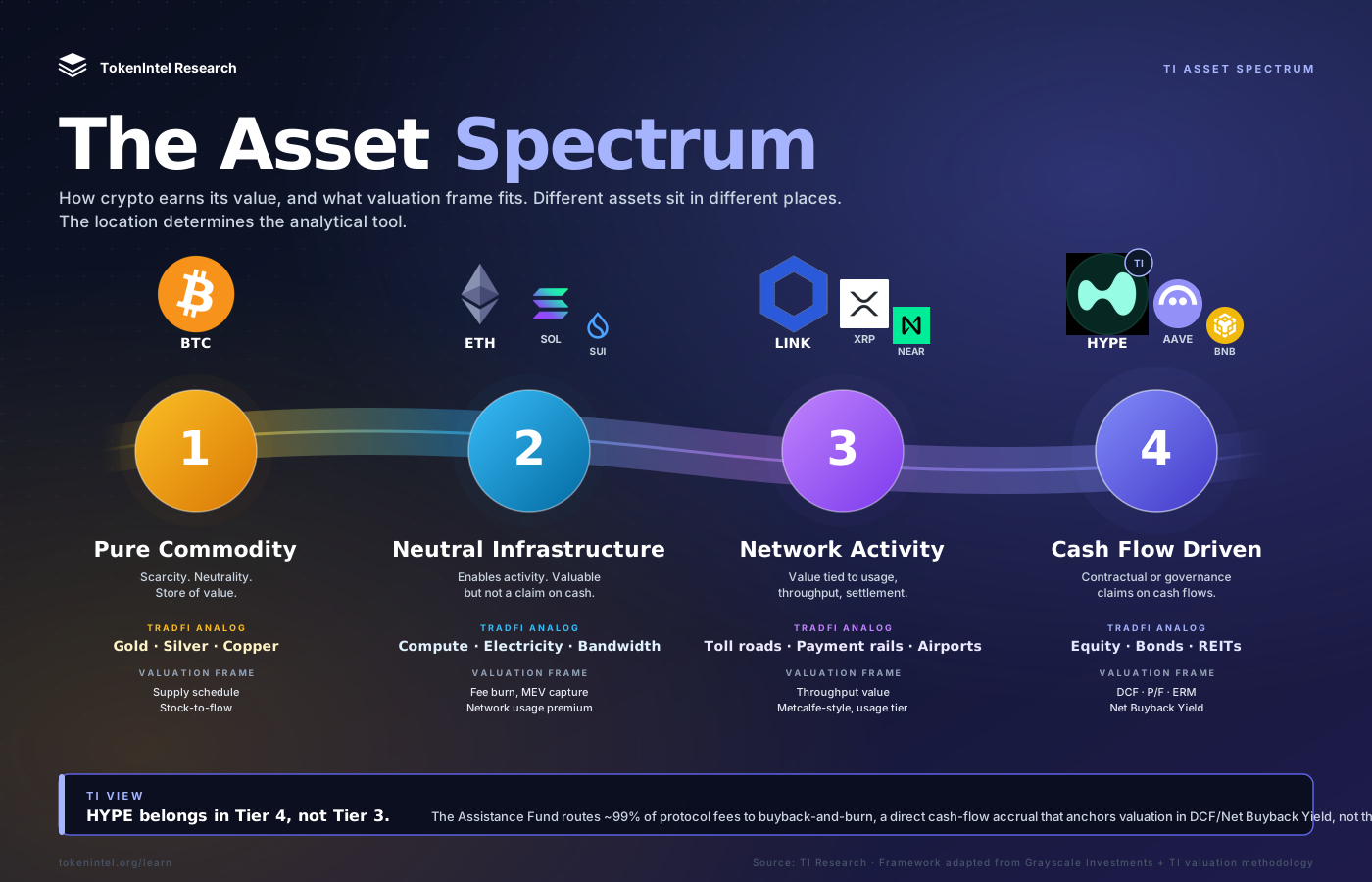
Where an asset sits on this spectrum determines the analytical tool that fits. Aave earns its value through contractual or governance claims on protocol cash flow, which sets the valuation frame above.
Fundamentals
Protocol Metrics
| Metric | Value | Trend |
|---|---|---|
| Total Value Locked | $14.6B net (DefiLlama, 2026-05-01) | Category leader, >5x nearest competitor |
| DeFi Lending Market Share | 40-45% | ↑ Dominant |
| Annualized Protocol Revenue | ~$44M (DefiLlama 30d run-rate, 2026-07-21) | ↑ Growing |
| Cumulative Deposits | $71T+ | ↑ Record |
| Chain Deployments | 12+ | ↑ Expanding |
TVL by Chain
Revenue Breakdown
Important Context: While Aave commands 40-45% of DeFi lending TVL, much of this is concentrated on Ethereum mainnet. Multi-chain expansion is increasing but L2 TVL remains a smaller portion of the total.
External Analyst Targets
Grayscale Research (Charlie Perkins, mid-June 2026) published a one-year price target of $175 for AAVE, derived from a discounted cash flow analysis applied to the post-Aavenomics fee-routing model. The published framing claims roughly 130% upside from their write-time price (~$76, consistent with the live AAVE spot of $74.66 per CoinGecko at the time of this update).
External cross-check (July 2026): on ~$122.8M TTM gross profit (economics retained after borrower interest is passed to depositors, not headline fees), AAVE trades around ~11.9x TTM revenue. Annualizing the weaker Q2 2026 instead lifts that to ~18x, a clean illustration of how rate- and cycle-sensitive the multiple is. On the same framing, ~9x would require normalized revenue near $160M and ~7x near $200M, so the current price embeds an assumption that recent revenue weakness and security issues are temporary. Mkt-cap-to-TVL is ~0.1x against ~$14.1B TVL and ~$10.7B active loans (neither of which accrues to the token, but both gauge the fee-generating base).
What the methodology assumes (and where to push back): the DCF requires Aave's annualized protocol revenue (~$44M run-rate per DefiLlama 30d as of 2026-07-21, materially below the ~$101M assumed in the May snapshot, which lowers the model output) to continue routing 100% to the DAO under Aavenomics, with buybacks compounding into reduced effective supply. The bull case requires Aave to defend ~40-45% DeFi lending market share against modular competition (Morpho's $10.81B blue TVL, Euler V2 emerging). The bear case is straightforward: if Aave's market share contracts, the revenue compounding does too, and the DCF terminal value falls disproportionately. Grayscale's report uses a single-scenario DCF; TI's view is that the appropriate frame is a fan of scenarios bounded by Aave's market-share defense vs cession.
Source: Grayscale Research, "Guide to Buying the Dip: Valuing Crypto with Cash Flows" (Charlie Perkins, Jun 2026). Live AAVE price per CoinGecko at the time of this update. The $175 target is Grayscale's view, not TI's; cited here as an external comparative data point. Last verified: 2026-06-17.
Technology
Lending Protocol Architecture
Aave operates as a system of liquidity pools where depositors provide assets to earn yield and borrowers draw from these pools using over-collateralized positions. Interest rates are determined algorithmically based on pool utilization.
| Feature | Description | Details |
|---|---|---|
| Lending Pools | Liquidity pools for each supported asset | Variable and stable interest rates |
| Flash Loans | Uncollateralized single-block loans | 0.09% fee, same-transaction repayment |
| Rate Switching | Toggle between variable and stable rates | User-controlled risk management |
| aTokens | Interest-bearing receipt tokens | Balance increases in real-time |
| Liquidation Engine | Automated liquidation of undercollateralized positions | Liquidation bonus incentivizes keepers |
| Isolation Mode | Risk-contained markets for newer assets | Limits exposure to volatile assets |
Multi-Chain Deployment
Aave is deployed across 12+ blockchain networks, including Ethereum, Polygon, Arbitrum, Optimism, Base, Avalanche, Metis, BNB Chain, Gnosis, Scroll, and zkSync. Each deployment operates independently with chain-specific risk parameters and asset listings.
Aave V4: Hub-and-Spoke Architecture (Live)
Aave V4 launched on Ethereum mainnet on March 30, 2026, backed by 345 days of security review and a $1.5M DAO-ratified security budget. It introduces a Hub-and-Spoke architecture with three distinct liquidity hubs, each serving different risk profiles. Available at pro.aave.com.
- Core Hub: General-purpose lending with 7 spokes (Main, Lido, EtherFi, Kelp, Lombard BTC, Gold, Forex)
- Prime Hub: Non-borrowable collateral venue for institutional-grade assets
- Plus Hub: Ethena ecosystem strategies with isolated caps
- Dynamic Liquidations: Variable liquidation bonuses replacing V3's fixed-threshold model
- Share-Based Accounting: Supply and debt tracked through shares, enabling different borrowing environments to settle against the same balance sheet
- Protocol Security Council: Emergency powers during initial hardening phase, transitioning to pause/freeze-only authority
GHO Stablecoin
GHO is an overcollateralized, decentralized stablecoin minted against deposits in Aave. Borrowers mint GHO by supplying collateral to Aave, and all interest paid on GHO goes directly to the Aave DAO treasury. GHO has expanded beyond Ethereum to Aptos (via Chainlink CCIP as a Cross-Chain Token) and other networks.
Ecosystem
Aave Products & Platforms
| Product | Description | Status |
|---|---|---|
| Aave V3 | Core lending protocol deployed on 12+ chains | Live (Production) |
| GHO Stablecoin | Overcollateralized stablecoin minted against Aave deposits | Live, expanding to Aptos |
| Horizon | Institutional RWA (Real World Asset) platform | In Development |
| Aave Arc | Permissioned DeFi pools for regulated institutions | Live (Limited) |
| Aave App | Consumer-facing mobile application for mainstream DeFi | Rolling Out |
| Aave V4 | Hub-and-Spoke architecture with Core, Prime, Plus hubs | Live (Mar 30, 2026) |
Multi-Chain Presence
Aave is Ethereum-native but has expanded to become a truly multi-chain protocol. Current deployments span across major L1s and L2s:
- Ethereum Mainnet: Primary deployment, majority of TVL
- Layer 2s: Arbitrum, Optimism, Base, Scroll, zkSync
- Alt-L1s: Polygon, Avalanche, BNB Chain, Gnosis, Metis
- Launched: Aptos (GHO via CCIP), additional L2s via V4
Institutional Adoption
Aave has made significant inroads into institutional DeFi through Aave Arc (permissioned pools with KYC/AML) and the Horizon platform for Real World Assets. Reported Horizon headline deposits passed the $500M mark in early 2026 (mixed figure including stablecoin lending liquidity); measured strictly on RWA tokens supplied as collateral, Horizon holds roughly $161M as of April 16, 2026 across USCC, USTB, VBILL, and JAAA (per Dune). Either framing tells the same directional story: regulated institutions are using Aave's permissioned rails as their preferred on-chain credit venue, with a target of $1B+ deposits by 2026. See the RWA Collateral Footprint callout in the thesis section for the cross-venue detail plus the live USCC→USTB rotation case study.
Between September 2025 and February 2026, supplied balances in the Aave V3 XAUT vault grew close to 10x. Tokenized gold (XAUT + PAXG) now represents ~95% of the $5.87B onchain commodity market cap, and Aave is absorbing a meaningful share of that supply as active, leveraged collateral rather than static exposure. The dynamic is holders deploying gold into credit markets instead of passively storing it. XAUT smart-contract interaction share crossed 75% of transaction count and 36% of transaction volume by 2025.
This is exactly the kind of asset a monolithic unified pool is built for: continuous price risk, deep offchain liquidity, globally recognised reserve role. Gold fits the profile that lets a pooled-liquidity model price the risk accurately, and the Aave XAUT vault's growth is a live confirmation. The next leg of the commodity-onchain story is yield-generating structures (e.g., Theo's thGOLD, RAAC's pmUSD commodity-backed stablecoin), which further cement Aave's role as the default venue for the monetary-collateral slice of the RWA market.
Source: DefiLlama / DLNews State of RWAfi Q1 2026 report (Aavescan data on XAUT V3 supply growth; Harvey et al., Tokenised Gold, Duke/NBER, on smart-contract interaction share). Last verified: 2026-04-23.
Structural Risk Advantage: DeFi lending carries a fundamentally different risk profile than traditional peer-to-peer lending. Overcollateralization ratios in Aave run between 150-180%, compared to 50-70% in traditional P2P lending platforms. Bad debt in DeFi comes primarily from oracle or smart contract failures, not creditworthiness defaults. Aave commands more than half of all DeFi lending borrows, a dominance driven by liquidity network effects: borrowers gravitate toward the deepest pools.
Aave App: The Aave App is a consumer-facing mobile application designed to bring DeFi lending to mainstream users. It simplifies the deposit-and-earn experience, abstracting away blockchain complexity for everyday crypto users.
Governance
Governance Structure
Aave is governed by the Aave DAO, where AAVE token holders vote on protocol upgrades, risk parameters, asset listings, and treasury management. Aave Labs (formerly Avara) serves as the primary development entity.
| Entity | Role | Influence |
|---|---|---|
| Aave DAO | On-chain governance body for protocol decisions | Final authority on all protocol changes |
| Aave Labs (fka Avara) | Primary development team and protocol steward | Core development, product roadmap |
| Safety Module | Staking mechanism for protocol insurance | AAVE stakers backstop protocol risk |
| Governance Forums | Off-chain discussion and proposal drafting | Community deliberation |
Governance Process
Aave governance follows a multi-step process for protocol changes:
- Forum discussion and Aave Request for Comment (ARC) posting
- Snapshot off-chain voting for temperature check
- Aave Improvement Proposal (AIP) submitted on-chain
- On-chain voting with AAVE tokens (quorum required)
- Timelock execution of approved proposals
Recent notable events
Aave Will Win (AWW) proposal passed, April 2026: Resolves the December 2025 governance dispute over application-layer fee diversion (the CoWSwap deployment controversy). The proposal consolidates 100% of revenue from all Aave-branded products under the DAO treasury, ends "payments for posting governance proposals," requires service providers to build exclusively for Aave, and allocates a one-time $25M stablecoin + 5,000 AAVE (~$6.8M) grant to Aave Labs to fund ongoing development. Aave Labs now works exclusively on Aave-branded products. Stani Kulechov's stated framing: "If you own AAVE, you own not just the economic rights of the protocol, but the brand, the users, and the integrations." Comparable in scope to Uniswap's UNIfication vote for UNI. See the Investment Thesis callout and ERM Snapshot for the financial re-framing.
December 2025 application-layer fee dispute (now resolved): A dispute erupted over accusations that CoWSwap deployment fees on Aave.com were flowing to an external recipient rather than the DAO treasury. This exposed a structural ambiguity about whether Aave Labs or the DAO controlled the protocol's user-facing products. AWW (above) answers the question decisively in favor of token holders.
Risk Factors
The risks below are scored in TokenIntel's six-dimension framework. For the underlying five mechanical risk channels, stress-adjusted coverage, recovery endogeneity, liquidity stress, oracle integrity, and execution viability, see the Vault Credit Risk framework.
Smart Contract Risk
Medium Risk- Core protocol is battle-tested with years of operation and multiple audits
- Multi-chain deployment increases total attack surface area
- V4 just launched (Mar 30), new architecture in early production with conservative parameters and Security Council oversight
- Flash loan exploits have targeted DeFi protocols historically
Administrative Architecture Lower Risk
Aave has the strongest administrative architecture of any major DeFi lending protocol, built on deliberate separation of powers between emergency response, governance, and treasury control.
- Dual 5-of-9 Guardians: Protocol Emergency Guardian (pause/freeze only) and Governance Emergency Guardian (veto malicious proposals) are separate multisigs with publicly named signers from independent organizations
- Separated powers: Guardian compromise = protocol freeze only. Cannot drain funds, upgrade contracts, or change parameters. This structurally contains a Drift-style key compromise
- Timelocks: 1-day delay for parameter changes (Level 1), 7-day delay for governance/upgrade actions (Level 2). Cross-chain governance adds additional destination-chain delays
- DAO-only upgrades: No individual or team can upgrade contracts unilaterally. Requires on-chain AAVE holder vote + timelock execution
- V4 reinvestment module: New risk surface, idle reserves deployed to governance-approved yield strategies. If a strategy fails, connected Spokes could face temporary illiquidity
Critical contributor exodus (April 2026): Chaos Labs, Aave's sole risk manager for 3+ years, terminated their engagement effective April 2026. During their tenure, Aave grew from $5.2B to $26B+ TVL with zero material bad debt, processed $2B+ in liquidations, and executed 2,000+ risk parameter updates. Chaos Labs cited three reasons: (1) core contributors (BGD Labs, ACI) departing increased workload, (2) V4's new architecture expands risk scope on an untested codebase, (3) the engagement was unprofitable even at $5M/year (their minimum estimate was $8M for V3+V4, roughly 5.6% of Aave's $142M revenue vs. the 6-10% banks allocate to risk). This leaves Aave without its primary risk infrastructure provider during the most complex transition in its history (V3 → V4 migration requiring dual-system operation). The "Ship of Theseus" problem: BGD Labs (protocol engineering), ACI (governance), and now Chaos Labs (risk) have all departed. The accumulated operational knowledge from three years of live-market risk management does not transfer in a handoff.
Sources: Aave Governance Documentation, Guardian Renewal 2024, ACL Manager Docs, Aave V4 Architecture Blog, Chaos Labs Departure Statement (April 2026).
Governance Risk
Elevated Risk- Risk-framework accountability: rsETH listing ignored BGD Labs' Feb 2025 DVN warning. During governance discussions for rsETH listing on Arbitrum and Base, BGD Labs explicitly recommended a multi-DVN configuration and flagged the single-DVN risk. The recommendation was not adopted. The April 2026 Kelp / LayerZero exploit materialized exactly this risk, the bridge's 1-of-1 DVN was compromised and Aave is now holding up to $230M in potential bad debt. Independent of whether Kelp or LayerZero bears more blame for the bridge itself, Aave's own risk framework accepted rsETH at up to 95% e-mode LTV without scoring the cross-chain bridge security posture. Going forward, any token whose value depends on a cross-chain bridge invariant needs the bridge's DVN / validator configuration incorporated into collateral risk review.
- December 2025 application-layer fee dispute (resolved): The CoWSwap fee-diversion dispute was resolved by the April 2026 Aave Will Win (AWW) proposal, which structurally redirects 100% of Aave-branded product revenue to the DAO. This materially reduces go-forward value-leakage risk from Aave Labs-controlled integrations but does not eliminate governance-capture concerns more broadly.
- AWW passed with concentrated delegation support: The "Aave Will Win" vote passed in part because of ~233K AAVE delegated from Aave Labs-associated addresses. The substantive content of the proposal is pro-holder (100% revenue to DAO), but the fact that Labs delegation was structurally decisive is a governance-concentration datapoint worth noting.
- Core contributor exodus: BGD Labs (protocol engineering), ACI (governance/growth), and Chaos Labs (risk management) all departed in Q1-Q2 2026. This removes the operational layer that built and maintained V3. AWW's requirement that service providers build "exclusively for Aave" may help attract replacement contributors on better-defined terms going forward.
- Chaos Labs departure exposes risk management gap: the team that managed zero bad debt across $26B TVL for 3 years is gone. No successor announced. V3+V4 dual operation requires continuous 24/7 risk management.
- V4 migration complexity: new architecture requires new risk infrastructure, new tooling, and new simulations from scratch. Second-order failure modes will only surface once real capital moves through the system.
- Post-AWW revenue allocation uncertainty: How the DAO splits consolidated revenue between buybacks, staking rewards, treasury reserves, and Labs opex will be determined by subsequent governance proposals. A sub-optimal allocation (e.g. too much to opex, too little to buybacks) would blunt the per-AAVE cashflow benefit AWW otherwise delivers.
User Concentration Risk
Elevated Risk- 28 whale addresses have cumulative borrows exceeding $1B each. 16 joined in the past year (78% growth in the whale cohort). The largest single borrow on record: $268.4M
- HHI (Herfindahl-Hirschman Index) analysis shows increasing concentration: typical days are driven by 2-3 effective cohorts, with frequent "whale days" where HHI spikes to 0.6-0.9 (near-monopolistic activity from a single cohort)
- On Base, the >$1B cohort consisted of just 6 wallets, some of which stopped activity entirely, highlighting how TVL and revenue can contract sharply if a handful of addresses leave
- The strategic implication: Aave's growth increasingly depends on retaining and attracting a small number of whale addresses, which may require "white-glove" institutional service rather than the permissionless DeFi model
Source: Joe Wait, "Under the Microscope: Aave" (Feb 2026). Whale data is directional; specific counts may have changed since publication.
Liquidation Resilience
Tested Under Stress- Largest single-day liquidation: ~$231M (Aug 5, 2024), followed by ~$170M (Feb 3, 2025). Protocol survived both with no bad debt, the liquidation engine has been tested at scale
- Average liquidation bonus: 5.2%, relatively size-agnostic (same bonus range for $100 positions and multi-million-dollar positions). Occasional spikes above 10% during extreme stress
- Two-regime liquidation pattern: retail positions liquidate steadily under normal volatility (0.4-0.6 range); whale/institutional positions only liquidate during extreme tail events (volatility >0.8). The bulk of systemic risk is concentrated in the far-right tail of the volatility distribution
- Liquidation is dominated by specialized, highly competitive keepers in a "race to lowest margins", ensuring rapid execution but creating dependency on a small number of sophisticated liquidators
Source: Joe Wait, "Aave's Liquidators" (Feb 2026).
Competition Risk
Medium Risk- Morpho offers peer-to-peer lending with better rates on matching
- Spark (MakerDAO/Sky) gaining TVL as an Aave fork
- Compound V3 simplifying lending with single-asset markets
- New lending protocols launching on emerging L2s
Regulatory Risk
Medium Risk- DeFi lending protocols face increasing regulatory scrutiny globally
- Potential classification as unregistered securities platforms
- KYC/AML requirements could challenge permissionless model
- US and EU regulatory frameworks still evolving for DeFi
Market Risk
Low Risk- Near full dilution (95%) reduces future supply pressure
- Strong and growing protocol revenue provides fundamental backing
- Buyback program creates consistent token demand
- However, price remains 70% below ATH despite record fundamentals
Sources & References
Official Resources
- Aave.com - Official Website
- Governance.aave.com - Governance Forum
- GitHub - Aave Protocol Source Code
Data & Analytics
Research & Documentation
- Aave Documentation - Technical Docs
- GHO Stablecoin - Documentation
- Artemis - "Digital Finance in 2030" (Mar 2026), Named Aave a winner in Lending; $1T+ cumulative loans milestone
- Multicoin Capital - "RWAs Are Just Built Different" (Mar 2026), Aave as RWA collateral infrastructure
- Electric Capital - "501 Sources of Real-World Yield" (Mar 2026), Aave Horizon, JAAA listing, looping strategies
- Token Dispatch - "DeFi's Risk Layer" (Mar 2026), V4 Hub-and-Spoke architecture, Horizon $580M+ deposits
- Aave Governance - ARFC: Aave V4 Activation on Ethereum Mainnet (Mar 2026), V4 live, Core/Prime/Plus hubs, 345 days security review
Disclaimer: This research is for informational purposes only and does not constitute financial advice. Cryptocurrency investments carry significant risk. Always conduct your own research and consult with a qualified financial advisor before making investment decisions.