Morpho (MORPHO)
Overview
Morpho is a decentralized, non-custodial lending protocol that functions as foundational infrastructure for on-chain credit. Its core primitive, Morpho Blue, is an immutable ~650-line smart contract enabling anyone to create isolated lending markets without governance approval.
Founded in 2021 by Paul Frambot, Merlin Egalite, and Mathis Gontier Delaunay (Telecom Paris). The team raised $73.6M from a16z, Variant, and Ribbit Capital. Morpho is deployed on Ethereum (primary) and Base, plus 12 EVM chains.
Primary Use Cases
- Permissionless Lending: Anyone can create isolated lending markets with custom parameters (collateral, loan asset, oracle, LLTV, IRM)
- Yield Aggregation: MetaMorpho vaults aggregate liquidity across markets via curators who manage risk allocation
- Institutional Credit: Apollo Global Management partnership ($940B AUM), Ethereum Foundation deployment
- RWA Lending: Approximately $400M in real-world asset exposure through specialized markets
Immutable Core: Morpho Blue is an immutable singleton contract with no admin keys, no proxy upgrades, and no governance-controlled parameters. Once deployed, the core lending logic cannot be changed by anyone, providing maximum security guarantees for depositors.
What matters most right now
As of April 2026- TVL $-- (live DefiLlama Morpho Blue); annualized fees $-- (live 7d run rate × 52).
- USD Curator Benchmark 3-month annualised return (3.79%) has converged with US Treasury yields (3.80%) (TI Research Changelog 2026-04-24), first DeFi lending surface where curator credit achieves rate parity with short-end Treasuries.
- Apollo Global Management partnership ($940B AUM) acquiring up to 90M MORPHO (9% supply) over 48 months, institutional validation unmatched by any other DeFi lending protocol (TI Research Changelog).
- Live RWA private-credit markets on Morpho: Pareto FalconX at ~92% utilization, Fasanara mF-ONE/USDC at 91.5% LLTV, the curator-layer-financing-RWA thesis is executing in production (TI Research Changelog 2026-04-23).
- Fee switch is OFF, revenue share to MORPHO holders is ZERO. All fees flow to lenders/curators. No announced activation timeline (structural). MORPHO is currently a pure infrastructure bet, not a cashflow asset.
- Curator concentration risk: top curators (Steakhouse, Gauntlet, Re7) control majority of TVL. Curator-level failure cascades directly into loss for vault depositors, not just aggregate protocol risk.
- USDe co-dependency: Morpho is a major USDe/sUSDe sink; Ethena events cascade into Morpho markets (see ethena.html for full Ethena status).
- Competitor pressure: Aave's AWW proposal (Apr 2026) just reactivated holder cashflow, if Morpho's fee switch stays off through 2026, AAVE/MORPHO relative valuation can re-rate materially.
Curator TVL recovery vs. fee-switch activation timeline, aggregate curator TVL recovered to ~$5B from ~$10B late-2025 peak (TI Research Changelog Apr 2026). If TVL returns to $8B+ without fee-switch activation, the "infrastructure bet" requires believing curator-layer dominance alone justifies the valuation. If fee switch activates at any meaningful share (>10%) of annualized fees, MORPHO becomes a cashflow asset.
Sources: DefiLlama live · TI Research Changelog (Morpho events Apr 2026) · Morpho public app + curator directory · CoinGecko. Block refreshed quarterly or on material change, flag staleness if the date above is >90 days old.
Investment Thesis
Morpho's investment case rests on its position as foundational lending infrastructure with immutable security guarantees, explosive user growth, and institutional validation from Apollo Global Management.
- Apollo Global ($940B AUM) acquiring up to 90M MORPHO tokens (9% supply) over 48 months
- Explosive growth: 67K to 1.4M users in 2025. TVL from $1.7B to $7B+
- Telegram deployment: Morpho vaults available to 150M+ Telegram Wallet users
- Immutable core = maximum security. No admin keys, no upgrade risk
- Dormant fee switch: $132M annualized fees to lenders. 25% cap = ~$38M protocol revenue if activated
- Zero protocol revenue today, fee switch is off with no timeline to activate
- High insider allocation (~53.5%) with ongoing unlocks through Nov 2027
- Curator model externalizes risk but does not eliminate it, bad curator decisions cause user losses
- Thin competitive moat, 650 lines of open source code is easily forked
- Governance concentration: 5/9 multisig executes decisions, 500K token proposal threshold
Key Catalysts
| Catalyst | Timeline | Impact |
|---|---|---|
| Morpho Midnight (fixed-rate lending) | "Almost ready" per team (Q1 2026 report); no specific date | High, targets the $200T global credit market vs. the current $60B crypto-backed loans TAM. Fixed-rate terms unlock institutional treasury / structured-product use cases that variable-rate DeFi cannot serve. |
| Fee Switch Activation | TBD (governance-controlled) | High - Up to ~$38M annualized protocol revenue at 25% cap |
| Apollo Token Acquisition | Ongoing (48-month program) | High - Institutional validation, sustained buy pressure |
| Telegram Wallet Deployment | Launched 2025 | Medium - Access to 150M+ Telegram Wallet users |
| Multi-Chain Expansion | Ongoing | Medium - Ethereum + Base + 12 EVM chains |
| Full Token Vesting | Nov 2027 | Medium - Removes overhang from scheduled unlocks |
0% protocol take-rate by design at the base layer. Curators (Steakhouse, Gauntlet, etc.) capture fees, not the protocol.
Source: DefiLlama protocol + dailyFees/dailyRevenue endpoints, 30-day windows annualized. As of 2026-04-30. How to read TVL · DefiLlama
Apollo Global Management's commitment to acquire up to 90M MORPHO tokens (9% of total supply) over 48 months represents one of the largest institutional commitments to a DeFi protocol. The Ethereum Foundation also deploys treasury assets through Morpho vaults. These endorsements validate Morpho's immutable infrastructure approach for institutional-grade lending.
An eligibility-adjusted revenue multiple on MORPHO produces a denominator of effectively zero. Morpho is one of the largest protocols in DeFi by TVL and one of the highest by annualized protocol fees, and the token has captured none of it since launch. This is the single most important framing for any valuation take on MORPHO that uses protocol-level numbers.
| Protocol TVL | $7.70B (DefiLlama Morpho Blue, 2026-07-21) |
| Annualized protocol fees | ~$150M |
| Direct flow to MORPHO holders | ~$0 since launch. Fee switch is off. Curator performance fees flow to vault curators, not the token. DAO treasury is controlled by token holders via governance but nothing is distributed to holders. |
| Fee switch design (if activated) | Capped at a maximum of 25% of interest paid by borrowers, and even then revenue would flow to the DAO treasury, not directly to MORPHO holders. Activation requires a governance vote with 500K MORPHO proposal threshold. |
| Upside at max-cap activation | Up to ~$38M/year to treasury, assuming current fee base holds. Still not a direct distribution to holders. |
| Circulating market cap | ~$1.04B (at $1.87, ~552M circulating) |
| Effective ERM | Undefined (division by zero). Even under the optimistic scenario of fee switch activation at the 25% cap with treasury-as-holder-proxy, ERM would be approximately $31 per $1 of forward annual treasury cashflow, which is still not holder cashflow. |
What this means. "Morpho P/S = $1.04B market cap / $150M annualized fees = ~6.9x" is a meaningless ratio for a MORPHO holder, because the holder receives zero of that $150M. The protocol is real, the revenue is real, the TVL is real, and the institutional adoption (Apollo, Ethereum Foundation) is real. MORPHO the token is a governance instrument with contingent future cashflow capture, not a cashflow instrument. A reader who is long MORPHO is betting that (a) governance activates the fee switch, (b) the activated fee switch routes value to holders rather than just the treasury, and (c) the fee base holds or grows. Every one of those is a discrete assumption that should be underwritten explicitly, not bundled into a multiple. See ERM explained. Last verified: 2026-04-09.
Tokenomics
MORPHO has a fixed total supply of 1,000,000,000 tokens with no inflation mechanism. Approximately 550M tokens are currently in circulation, with the remainder subject to vesting schedules through November 2027. Near full dilution is approaching, which reduces future sell pressure from scheduled unlocks.
Corporate structure: there is no equity to buy
In June 2025, Morpho Labs SAS (the French for-profit software company that builds the protocol) became a wholly-owned subsidiary of the Morpho Association, a French 1901-law nonprofit. Under French nonprofit law, the Association cannot have shareholders, distribute profits, or be sold. Because Labs is now wholly owned by the Association, there is no independent operating equity either. The framing from co-founder Paul Frambot was that the move removes the structural conflict between equity holders (who capture company value) and token holders (who capture token value). The practical consequence is that MORPHO is the only asset an outside investor can own in the protocol. This is why the June 2026 raise was structured as a token-purchase agreement at market price rather than a priced equity round: there was no equity to issue.
Sources: DL News, "Crypto lender Morpho bucks DeFi trend as nonprofit absorbs development team" (Jun 2025); Morpho blog, "Aligning Around MORPHO" + "Morpho Effect: June 2025."
Supply Metrics
| Metric | Value | Notes |
|---|---|---|
| Total Supply | 1,000,000,000 MORPHO | Fixed, no inflation |
| Circulating Supply | ~550,000,000 MORPHO | ~55% of total supply |
| Insider Allocation | ~53.5% | Founders + Investors + Contributors |
| Vesting End | November 2027 | Cohort 3 investor vesting completion |
| Protocol Revenue | $0 | Fee switch currently off |
| Fees to Lenders | $150M annualized | All fees flow to lenders, not protocol |
MORPHO Token Distribution
Fee Switch Mechanism
Morpho governance controls a dormant fee switch that can capture up to 25% of the interest paid by borrowers. Currently, 100% of interest flows directly to lenders. If activated, the fee switch would generate approximately $33M in annualized protocol revenue based on current lending volumes. There is no publicly stated timeline for activation.
Revenue Model
Today, Morpho generates zero protocol revenue. All $150M in annualized fees flow to lenders. Curator fees (charged by MetaMorpho vault managers) flow to curators, not to MORPHO token holders. The protocol's entire value accrual thesis depends on future fee switch activation, making it a pure growth-stage bet on infrastructure adoption.
Token Holder Rights
MORPHO token holders have governance rights over the protocol, including control over the fee switch, approved LLTVs, and interest rate model parameters. However, there is currently no staking yield, no burn mechanism, and no direct revenue accrual.
Rights Breakdown
| Right | Mechanism | Current Value | Sustainability |
|---|---|---|---|
| Governance Voting | Snapshot voting weighted by MORPHO | Token-weighted votes | ✓ Structural |
| Fee Switch Control | Governance can activate up to 25% fee | Currently OFF | ◔ Potential |
| LLTV Governance | Approve new loan-to-value tiers | Active parameter | ✓ Structural |
| IRM Governance | Approve new interest rate models | Active parameter | ✓ Structural |
| Proposal Submission | 500K MORPHO required to submit | High threshold | ◔ Concentrated |
How Value Could Flow to Token Holders
- Fee Switch Activation: If governance activates the fee switch at the maximum 25% rate, approximately $33M in annualized revenue would flow to the protocol based on current volumes.
- Governance Power: MORPHO holders vote on critical protocol parameters including LLTV tiers, interest rate models, and the fee switch itself.
- No Current Yield: Unlike Aave (staking + buybacks), Morpho offers no staking yield, no burn mechanism, and no direct revenue distribution to token holders today.
Value Accrual Gap: Morpho's token value depends entirely on future fee switch activation. With zero current revenue accrual, MORPHO is priced on growth expectations and institutional endorsement rather than cash flows. This represents a fundamentally different risk profile than revenue-generating DeFi tokens like AAVE.
Where Morpho sits in the TI Asset Spectrum
Morpho is structurally Tier 4 (Cash Flow Driven), though the protocol fee switch is currently off. When activated, MORPHO value accrual becomes DCF and P/F shaped against the curator-layer protocol fees. The asset is positioned for the cash-flow tier; the open question is when (and whether) governance flips the switch.
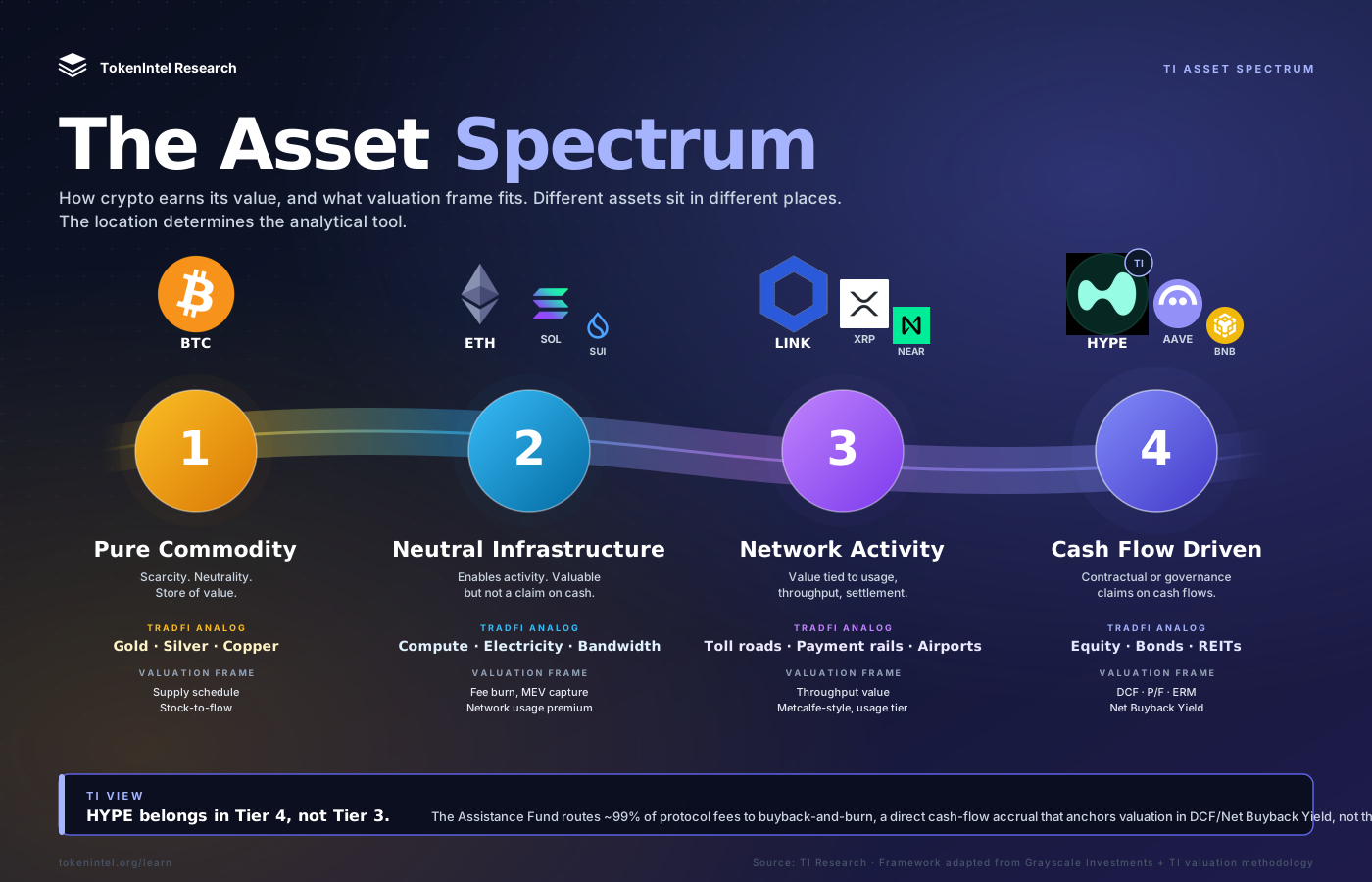
Where an asset sits on this spectrum determines the analytical tool that fits. Morpho earns its value through contractual or governance claims on protocol cash flow, which sets the valuation frame above.
Fundamentals
Q1 2026 quarterly snapshot (Token Terminal)
Source: Token Terminal Q1 2026 Morpho reportQ1 was a quarter of consolidation. Active loans flat at $3.64B while TVL eased -3.3% on broad market softness, pushing utilization up to 37.75%. Fees fell -33% QoQ but this was rate compression, not borrower demand, the implied annualized lending rate dropped from ~5.77% to ~3.85% across the sector. Market share gained 2.11pp at Aave's expense (Aave: 64.43% → 63.22%), Morpho's largest single-quarter share gain on record.
Chain diversification trajectory is striking. Ethereum's share of Morpho TVL fell from 86.69% a year ago to 54.87% in Q1, with Base capturing most of the migration (13.12% → 34.18%). The Coinbase crypto-backed loans deployment ($2B in collateral by Q1 close) is the primary driver. HyperEVM holds 5.31%, Arbitrum 3.34%. Morpho is now one of the most rapidly diversifying lending protocols by chain distribution.
Of $3.91B in vault deposits, Steakhouse Financial holds $1.67B (~43%) and Gauntlet $1.17B (~30%), combined 73%. Both crossed $1B for the first time in Q1. Annualized curator fees grew from sub-$2M to $13M in 2025 (600% growth), with 30+ active curators managing over $4B. The model is maturing, but two-curator concentration of this magnitude means a curator-level allocation failure cascades directly into vault depositor loss without protocol-level cushion.
AI-era threat-model addendum (May 2026): the March 2026 Resolv / Morpho cascade (~$200K of attacker capital triggered an $80M unbacked USR mint and ~$3.8M of bad debt across Morpho markets via oracle latency + automated allocators sustaining inflows into stressed markets) is the canonical case for AI-era operational-security risk on a permissionless lending protocol. TI's risk methodology has been recalibrated to weight oracle update cadence on stress-correlated collateral and auto-allocator stress-conditionality more heavily. Background: methodology calibration · AI x Crypto Security synthesis.
Protocol Metrics
| Metric | Value | Trend |
|---|---|---|
| Total Value Locked | ~$7.0B | ↑ Strong Growth |
| Loans Outstanding | ~$3.0B | ↑ Growing |
| Users | 1.4M+ | ↑ 20x in 2025 |
| Annualized Fees (to Lenders) | $150M | ↑ Growing |
| Protocol Revenue | $0 | -- Fee switch off |
| DeFi Lending Rank | #2 | ↑ Behind Aave |
| Active Markets | 180+ | ↑ Expanding |
Growth Trajectory
Competitive Position
Revenue Paradox: Morpho ranks #2 in DeFi lending TVL and generates ~$247M in annualized fees (DefiLlama 7d run rate, Apr 2026), yet captures zero protocol revenue. All fees flow to lenders / curators. The fee switch remains dormant with no announced activation timeline, making MORPHO a pure growth-stage infrastructure bet.
Technology
Morpho Blue: Immutable Core
Morpho Blue is a singleton smart contract of approximately 650 lines that provides the fundamental lending primitive. It is fully immutable, once deployed, the core logic cannot be changed, upgraded, or paused by anyone, including the Morpho team. Each market is defined by five parameters: collateral asset, loan asset, oracle, liquidation LTV (LLTV), and interest rate model (IRM).
| Feature | Description | Details |
|---|---|---|
| Immutable Singleton | ~650 lines, no proxy, no admin keys | Cannot be upgraded or paused |
| Isolated Markets | Each market has independent risk parameters | No cross-market contagion |
| Permissionless Creation | Anyone can create a market | No governance approval needed |
| Oracle-Agnostic | Market creator chooses oracle | Chainlink, Redstone, Uniswap TWAP |
| Formal Verification | Mathematically proven correctness | Audited by Spearbit, Cantina |
| Bug Bounty | $2.5M maximum payout | One of the largest in DeFi |
MetaMorpho Vaults: Curator Layer
MetaMorpho vaults sit on top of Morpho Blue and aggregate liquidity across multiple isolated markets. Curators manage vault allocations, choosing which markets to supply to and how much capital to deploy. This creates a separation between the immutable lending primitive (Morpho Blue) and the active risk management layer (MetaMorpho).
Role Separation
MetaMorpho vaults implement a role-based governance model with three distinct roles to prevent single points of failure:
- Curator: Sets which markets a vault can allocate to and configures supply caps. Has configurable timelocks (0-3 weeks) before changes take effect.
- Allocator: Manages the day-to-day distribution of vault capital across approved markets. Cannot add new markets or change risk parameters.
- Sentinel (Guardian): Can revoke pending changes or reallocate in emergencies. Acts as an oversight check on curator decisions. No single role can drain funds.
Multi-Chain Deployment
Morpho is deployed on Ethereum (primary) and Base, with support for 12 EVM-compatible chains. The immutable core contract is deployed identically on each chain, while MetaMorpho vaults and curator configurations vary by deployment.
Ecosystem
Key Integrations & Partnerships
| Partner | Description | Status |
|---|---|---|
| Apollo Global Management | $940B AUM, acquiring up to 90M MORPHO (9% supply) over 48 months | Active |
| Ethereum Foundation | Treasury assets deployed through Morpho vaults | Active |
| Telegram Wallet | Morpho vaults accessible to 150M+ Telegram Wallet users | Launched |
| Steakhouse Financial | Top curator managing significant MetaMorpho vault TVL | Active |
| Gauntlet | Risk management and vault curation services | Active |
| Re7 Labs | Institutional-grade vault curation | Active |
Curator Ecosystem
The curator model is central to Morpho's ecosystem. Curators are professional risk managers who build and operate MetaMorpho vaults, choosing which markets to allocate to and managing risk parameters. Top curators control the majority of Morpho's TVL, creating a concentrated but specialized risk management layer.
- Professional Curators: Steakhouse Financial, Gauntlet, Re7 Labs, and others manage billions in vault TVL
- Curator Fees: Curators charge performance and management fees that flow to them, not to MORPHO token holders
- Risk Externalization: Morpho's immutable core pushes all risk management decisions to the curator layer
Upstream dependency: Ethena (USDe / sUSDe)
USDe and sUSDe sit inside Morpho as collateral and borrow assets in multiple curator vaults, so any Ethena-side event cascades directly into Morpho's risk surface. As of April 2026, the relevant Ethena updates to keep in view:
- Four-pillar reserve diversification (Apr 2026). Ethena moved away from pure basis-trade backing toward institutional USDC lending (Anchorage, Maple, Coinbase Asset Mgmt), expanded RWA exposure, HyENA equity/commodity basis on Hyperliquid, and prime-broker relationships. Lower basis-trade dependence = different stress profile for Morpho USDe markets.
- USDe co-dependency with Aave (~50% of supply in Aave loops), a shock that breaks the loop economics on Aave also affects USDe supply on Morpho, because USDe demand across venues is linked.
- Operational track record across 3 stress events. Bybit incident ($30M resolved via Copper Clearloop with no depeg), Oct 10/10 orderly contraction, and the April 2026 Kelp/LayerZero response (bridges paused within hours, PoR published on-chain). A positive read for Morpho-hosted USDe vaults; still a single-issuer dependency.
Full context on the Ethena research page.
RWA Footprint: #1 DeFi Venue for Tokenized Real-World Assets
Of roughly $2.7B in RWA tokens actively deposited across DeFi lending markets in April 2026, Morpho hosts the single largest share: ~$957M across 41 tokenized RWA assets on 10 chains. This makes Morpho the #1 composable-RWA venue in DeFi, ahead of Aave's broader markets ($929M), Kamino ($587M), Aave Horizon ($161M), and Fluid ($109M).
| Morpho RWA footprint (Apr 16, 2026) | Value | Note |
|---|---|---|
| Total composable RWA on Morpho | ~$957M | 41 assets, 10 chains |
| Maple syrup tokens (credit) | Largest single category | syrupUSDC / syrupUSDT, positive-carry leverage loops |
| Re Protocol reUSD (reinsurance) | ~$96M | Includes ~$50M in Pendle PT-reUSD |
| Pendle PT collateral (all RWA PTs) | ~$58M | Fixed-rate layer on top of underlying RWA |
| Pareto AA_FalconXUSDC / USDC (Apr 2026) | ~$48M | Tokenized private credit vault receipt posted as collateral. 77% LLTV, 91.96% utilization, borrowing demand is absorbing most of the available liquidity. |
| Fasanara mF-ONE / USDC (Apr 2026) | ~$20M | Second live example of the same pattern: tokenized private-credit exposure used as programmable collateral rather than static holdings. 91.5% LLTV. |
Gauntlet's Aera vault automates the carry loop into a managed strategy with pre-defined risk controls, in practice, close to an onchain repo-like structure for private credit. This is what makes the Morpho curator layer more than distribution: curators are building the structured-leverage rails on top of the permissionless collateral markets, which is where fee capture accretes.
The curator moat. What's distinct about Morpho's RWA footprint is that professional curators like Gauntlet and Steakhouse run vaults that allocate capital into these markets and build structured leveraged strategies on top. In the case of Maple, Gauntlet built leveraged syrupUSDC vaults without coordinating with Maple, the asset was permissionless, so the curator composed it. That's distribution through code rather than through BD. As more RWAs launch composable-by-design, Morpho's permissionless architecture plus a mature curator ecosystem captures a disproportionate share of the flow.
Why the TVL number alone understates this. A TVL chart treats $1 of MORPHO-vaulted ETH and $1 of MORPHO-vaulted syrupUSDC as equivalent. They aren't. The RWA slice represents a different, more durable source of demand: institutional capital seeking fixed-income exposure on DeFi rails, plus leveraged curator strategies that are sticky once wired in. The implication for MORPHO token valuation is that fee capture from this slice should hold up better than crypto-native lending fees in a down market.
Framework: The RWA Composability Framework. Sources: Dune (April 2026 RWA composability analysis); DefiLlama State of RWAfi Q1 2026 report (Pareto FalconX + Fasanara mF-ONE market data); Gauntlet Aera vault documentation. Apollo (ACRDX) partnership provides additional institutional credit flow. Last verified: 2026-04-23.
Infrastructure Thesis: Unlike pool-based lending protocols (Aave, Compound) where the protocol itself manages risk parameters, Morpho separates the immutable lending layer from active risk management. This makes Morpho Blue function more like foundational infrastructure (similar to Uniswap V4 hooks) than a managed lending product.
Institutional channel stack: who is actually plugged into Morpho
Morpho's TVL chart hides the more interesting story: the channel partners routing user balances and institutional collateral through Morpho-curated vaults. The base-rate read is that exchanges, asset managers, and tokenized-securities issuers picked the protocol with an immutable core and a separate risk layer over the protocols that bundle them. The list below is what we could verify with primary sources, not a marketing roster.
Verified channel partners (Jun 2026)
| Channel | Curator | Scope, verified | Primary source |
|---|---|---|---|
| Coinbase Loans | Steakhouse Financial | $2.17B+ total loan originations through Morpho as of Apr 14, 2026 (BTC-backed USDC loans, ~$1.4B of cbBTC posted as collateral, expanded to ETH-backed and SOL-backed loans in 2026) | morpho.org/stories/coinbase |
| Binance Wallet Earn | Steakhouse + Gauntlet | USDT and USDC earn flow routed to Morpho vaults: Steakhouse USDC vault TVL ~$437M, 3.6% yield at time of read | Binance Wallet Earn product page; DefiLlama vault tracker |
| Apollo ACRED (Diversified Credit Securitize Fund) | Gauntlet (levered strategy) | Tokenized private-credit fund accepted as collateral on Morpho across Ethereum, Polygon, and OP Mainnet; Securitize+Gauntlet launched a levered RWA strategy on top | Apollo + Securitize joint release; Morpho vault registry |
| SG-FORGE (Societe Generale) | MEV Capital, Spark | EURCV and USDCV tokenized money market funds usable as collateral and supply in Morpho vaults: institutional EUR/USD rail with a regulated bank issuer | SG-FORGE Morpho vault launch announcement |
| Ethereum Foundation treasury | Multiple curators | Treasury assets deployed through Morpho vaults: signal of trust in the immutable-core architecture from the most paranoid steward in the ecosystem | EF treasury disclosure |
| Telegram Wallet | Multiple curators | Morpho vaults exposed to the 150M+ Telegram Wallet user base as a yield destination | Telegram Wallet product release |
Apollo cooperation agreement (Feb 2026): Apollo Global Management ($940B AUM) committed to a 48-month MORPHO accumulation plan: up to 90M tokens (~9% of supply) acquired over the period. That is not a token grant or vesting unlock, it is a counterparty with hard-asset RWA flow buying spot. Combined with ACRED already onchain as Morpho collateral, the read is asset-manager-as-strategic-channel, not asset-manager-as-press-release.
June 8, 2026 raise ($175M, ~$2B FDV): Co-led by Paradigm, a16z crypto, and Ribbit Capital, with strategic participation from Apollo Funds, Circle Ventures, VanEck, and Ledger Cathay. The Morpho Association ($175M to its treasury for the "open credit network" buildout) called it the largest raise in DeFi history per co-founder Merlin Egalite. The mechanical structure is the unusual part: investors bought MORPHO at its average monthly market price as a token purchase agreement, not a private mark. There is no equity changing hands, because there is no equity to issue (see corporate structure note in Tokenomics). The "$2B valuation" headline is the token's FDV at the purchase price, not a negotiated private round. What the round actually signals is investor willingness to buy the existing token at market in size, alongside Apollo's earlier accumulation commitment.
Why these channels chose modular over bundled
Per Tiger Research's framing (May 2026 modular DeFi lending report), the institutional preference for Morpho is not yield-driven. The protocols that bundled their own curation (Aave, Compound) ask channel partners to inherit the protocol's risk choices wholesale, including which collateral types, oracle providers, and liquidation parameters are in scope. Morpho's separation lets a Coinbase or a Societe Generale specify the exact market shape they need (collateral whitelist, oracle source, LTV ladder) without taking on every other curator's risk surface. The Reserve Primary Fund anchor is direct: 2008 broke a money market fund because contagion crossed walls that should have been isolated. Morpho's immutable per-market design is the answer to that exact failure mode.
Modular lending architecture: Morpho vs Aave V4 vs Euler V2
The three current modular-lending designs solve the same correlation problem with three different topologies. The comparison table below uses Tiger Research's framing (prime brokerage / universal bank / multi-strategy pod) and pairs it with the verified TVL split as of June 2026.
| Protocol | Architecture metaphor | Risk topology | Total TVL (DefiLlama, Jun 2026) |
|---|---|---|---|
| Morpho Blue | Prime brokerage | Immutable isolated markets, every (collateral, loan, oracle, LLTV) tuple is its own market. Risk lives in the curator layer above, not in the protocol | ~$10.78B (Ethereum $3.58B, Base $2.83B, Hyperliquid L1 $377M, Monad $92M, Katana $88M) |
| Aave V4 | Universal bank, hub-and-spoke | Liquidity hub at the center with GHO as the routing asset; spokes are specialized vaults that borrow from the hub against narrower collateral sets. Aave Horizon adds permissioned RWA spokes | Multi-billion across V3 and V4 markets (V4 still ramping) |
| Euler V2 | Multi-strategy hedge fund, pod structure | Ethereum Vault Connector (EVC) groups vaults into clusters that can cross-margin within a cluster but stay isolated across clusters. EVK is the vault SDK that lets builders ship custom risk logic | ~$935M (Ethereum $124M, Monad $93M, Plasma $17M, Base $16M, Avalanche $5M) |
The honest read: Morpho is winning the channel-partner game today because the prime-brokerage shape matches what Coinbase, Binance, and Apollo actually need (a single, scoped, isolated market they can underwrite). Aave V4's universal-bank shape is more capital-productive at scale but exposes channels to the full hub's risk choices. Euler V2's pod structure is the most expressive but smallest in TVL, the EVK developer surface is doing the work to catch up. Whether Morpho holds the lead depends on whether the curator layer remains underwriting-grade as more institutional flow lands on it (see curator-concentration section below).
On April 18, 2026, an attacker drained Kelp's LayerZero bridge via a 1/1 DVN configuration flaw and minted 116,500 unbacked rsETH (~$292M), the wallet funded through Tornado Cash ten hours earlier. The attacker then deposited the unbacked rsETH on Aave V3 as collateral and borrowed ~126,000 WETH (~$236M), leaving the protocol with bad debt that public estimates ranged from $177M to $230M depending on whether losses were confined to L2 markets or shared across the rsETH universe.
The pooled-architecture cost compounded fast. Per Aave's own governance post and the contemporaneous coverage, the WETH pool hit 100% utilization, withdrawals froze, and depositors ran for the exit. Total deposits fell from $44.2B to $29.3B over 3.5 days, an outflow of roughly $14.9B (−33.7% of the protocol's capital), and the run did not stop there: deposits kept bleeding for seven weeks to a trough of $20.7B on Jun 7, −53.1% from the pre-event level. Aave's Umbrella backstop, the protocol's automated bad-debt slasher on staked aTokens, was activated to cover the shortfall (~$54M aWETH was available against a projected ~$91.8M Core deficit).
Morpho had minor exposure to the same exploit through rsETH-collateralized markets, but every affected market was isolated: the bad debt sat in the single (rsETH, oracle, LLTV) market that took it, and could not propagate to the curator vaults that did not opt into it. The market-level loss was real; the protocol-level run was not.
Deposit figures corrected 2026-08-21. This passage previously read "$48.5B to $30.7B... an outflow of roughly $15.1B (~33%)". Those endpoints did not reconcile with their own stated delta ($48.5B minus $30.7B is $17.8B, not $15.1B). Recomputed from DefiLlama Aave V3 (net TVL plus borrowed, summed across chains): $44.2B on Apr 18 to $29.3B on Apr 22, an outflow of $14.9B, or −33.7%. The original outflow figure was close to right; the levels were not. The seven-week extension to −53.1% was absent from the original and is the stronger evidence for the argument this section makes.
Why this matters for the comparison above. The architecture argument for Morpho's isolated-market shape used to be theoretical: "a bad collateral cannot cascade." April 18 was the moment it was tested at scale. Aave survived (its Umbrella backstop and reserve quality did what they were designed to do), so this is not a case for Morpho being uniquely safe. It is a case for the modular shape being uniquely contained: when a single market fails, the rest of the system does not have to defend itself against contagion. That is the institutional-credit property that drove the rest of the channel adoption table above.
Sources: Aave governance forum, "rsETH incident, 2026-04-18"; CoinDesk, "Aave could face up to $230M in losses after Kelp DAO bridge exploit" (Apr 20, 2026); CoinDesk, "2026's biggest crypto exploit: Kelp DAO hit for $292M with wrapped ether stranded across 20 chains" (Apr 19, 2026); KuCoin Learn, "KelpDAO rsETH Exploit"; BeInCrypto, "Aave WETH Bad Debt Warning"; Glassnode Insights, "Anatomy of a Liquidity Freeze."
Sources: Coinbase Loans product disclosure (Apr 2026); Binance Wallet Earn product page; Apollo + Securitize ACRED release; SG-FORGE Morpho vault launch; DefiLlama protocol TVL endpoints for Morpho Blue and Euler V2 chain breakdowns (Jun 2026); Tiger Research, "Modular DeFi Lending: A New Architecture" (May 2026). Cross-checked vs Steakhouse and Gauntlet curator dashboards. Last verified: 2026-06-17.
The curator layer: where Morpho's risk actually lives
Morpho's immutable core pushes all risk management to the curator layer. That makes the distribution of capital across curators, and the relationships between them, a first-order risk question, not a UX preference. A curator-level analysis of the Morpho ecosystem, shared by Anastasiia (@mathy_research) at the April 2026 Vault Summit, makes the concentration and its correlation structure visible in a way the protocol-level TVL chart does not.
The industry context (cross-protocol, not Morpho-only): risk curation has become an oligopoly across all lending protocols, with the top four curators controlling roughly 65% of the ~$7B in total curated TVL industry-wide. Curator economics resemble traditional asset management, with performance fees up to 50% and management fees up to 5% annually. Steakhouse Financial manages ~$1.7B with a team under 20 people, taking ~5% of interest generated. Morpho's deliberate strategy is to run its own protocol fee at zero and route that value to curators and the token ecosystem to grow the network. That is the MORPHO value-accrual question in one sentence: the protocol subsidizes an increasingly profitable curator layer, and token holders are betting the network effect eventually pays them back. Per Tiger Research stablecoin value chain report, July 2026.
Curator TVL concentration
Across the Oct 2024 - Nov 2025 observation window, approximately $7.27B of TVL is concentrated across eight large curators. The top of the distribution is heavy, and the market-leading curators control multiples of what the mid-tier does:
| Curator | TVL | Share of observed curator base |
|---|---|---|
| Gauntlet | ~$2.0B | 27.6% |
| Steakhouse | ~$1.29B | 17.8% |
| MEV Capital | ~$915M | 12.6% |
| K3 Capital | ~$478M | 6.6% |
| R7, Block Analitica, Yearn, B Protocol (mid-tier) | combined | ~35.4% |
| Long tail (smaller curators) | , | ~20% |
Network centrality: hub status is not the same as TVL
TVL rank is the obvious way to look at the field. It is also the wrong way. When curators are evaluated by their position in the market-overlap graph, which curators are underwriting the same collateral in the same markets, the hubs are not who you would guess from the TVL table.
Measured by eigenvector centrality in the curator-market bipartite graph:
- Top tier (~0.43-0.46): B Protocol and Block Analitica. Mid-sized by TVL, maximally connected by market overlap. They are the ecosystem's bridges.
- Second tier (~0.32-0.40): Gauntlet, MEV Capital, Steakhouse. Large by TVL, connected but not the hubs of the overlap graph.
- Peripheral (~0.21-0.30): K3 Capital, Yearn, R7. Narrower collateral focus, fewer shared-market edges.
Why this matters. Systemic importance in a modular credit system is defined by connectivity, not only scale. A curator two-thirds the TVL size of Gauntlet can be a more important node in the overlap graph if its collateral choices intersect broadly with other curators' books. When a shared collateral asset degrades, the pathway for stress to spread runs through the high-centrality curators first, regardless of which curator is largest.
Downside co-movement: the correlation structure in stress
Curator drawdowns in normal conditions look like a single tightly coupled core clustering around the hubs:
- B Protocol / Gauntlet: 0.72 drawdown correlation
- Block Analitica / Gauntlet: 0.80
- B Protocol / Block Analitica: 0.62
More importantly, when the data is restricted to bottom-decile daily log TVL returns, the acute-stress regime, not average conditions, the co-movement persists:
- B Protocol / Block Analitica: 0.68 lower-tail correlation
- B Protocol / K3 Capital: 0.59
- B Protocol / R7: 0.63
This is the relevant finding for a depositor sizing tail risk. "Diversify across curators" is not protective if the curators you are diversifying across are all drawing from the same underlying markets, their returns stay correlated exactly when diversification is supposed to help.
Two curators behave differently, and the difference is informative:
- Steakhouse sits near-zero with the core cluster (0.09 with B Protocol, 0.25 with MEV Capital). That's consistent with a cash-management-like posture rather than active collateral underwriting, a different risk family, not a safer version of the same risk family.
- Yearn is weakly or negatively correlated with most peers (−0.49 with Gauntlet, −0.30 with B Protocol). The driver looks like market beta rather than shared collateral positioning. Yearn's vaults trace a different yield source than the direct-lending core does.
Fee capture: what the curator is actually being paid for
Average curator revenue as a share of gross fees on managed vaults varies widely, and the dispersion maps onto what the curator is actually doing for the depositor:
| Curator | Avg. revenue share of gross vault fees | Implied posture |
|---|---|---|
| R7 | ~16% | Performance-fee-like active management |
| Block Analitica | ~14% | Active underwriting |
| K3 Capital | ~10% | Active underwriting |
| MEV Capital | ~9% | Active underwriting |
| B Protocol | ~8% | Active underwriting |
| Gauntlet | ~7% | Risk-oversight / institutional |
| Steakhouse | <3% | Utility-like / cash-management |
| Yearn | <3% | Utility-like / aggregation |
At the top end, revenue share approaches what performance-fee-based managers in TradFi charge for active strategy execution. At the bottom end, it approaches a utility model, the curator is a risk-oversight function on top of otherwise passive capital. Paying 16% for risk oversight that could be had for 3% is a category error; paying 3% and expecting active-management differentiation is the reverse error.
Takeaway for a Morpho depositor or MORPHO holder. Morpho's market structure isolates credit risk at the individual market level, but liquidity stress is partially mutualized through shared underlying markets and overlapping curator positioning. Curator selection is a first-order risk decision, not a UX preference. Four questions to ask of any Morpho vault before supplying: (1) Which curator is running it? (2) What is their collateral concentration (factor-HHI across their book)? (3) What is their tail-correlation with the largest curators, not just their average-conditions correlation? (4) What fee structure are you paying, and does it match the kind of work the curator is doing for that vault?
Total on-chain curator TVL across all protocols has rebuilt toward ~$5B, recovering from the sharp decline off the late-2025 ~$10B peak that followed February's leverage unwind. The USD Curator Benchmark's 3-month annualized return (3.79%) has converged with US Treasury yields (3.80%), the first period of near-parity since the yield compression began. Morpho is the single largest venue inside this category, so category-level TVL and yield health translate directly into activity on MORPHO markets even when the specific aggregates sum across venues.
Source: Glassnode Strategy Watch #3, March 2026.
Curator data per Anastasiia (@mathy_research), "DeFi Lending Credit Risk: A Three-Part Framework" (Vault Summit, April 2026). Observation window: October 1, 2024 - November 19, 2025. TVL-based statistics reflect combined signal of market beta and liquidity dynamics. Category-level curator figures from Glassnode Strategy Watch #3 (March 2026). For the broader mechanical-risk framework behind these curator metrics, see Vault Credit Risk: five mechanical channels.
Governance
Governance Structure
Morpho is governed by the Morpho Association, a French nonprofit (Association Loi 1901). Governance decisions are made through Snapshot voting weighted by MORPHO token holdings, with a 5/9 governance multisig executing approved decisions on-chain.
| Entity | Role | Influence |
|---|---|---|
| Morpho Association | French nonprofit overseeing protocol development | Legal entity, strategic direction |
| 5/9 Governance Multisig | Executes governance-approved decisions on-chain | On-chain execution authority |
| MORPHO Token Holders | Vote on proposals via Snapshot | Token-weighted voting power |
| Morpho Labs | Core development team | Protocol development, product roadmap |
Governance Process
Morpho governance follows a forum-first process:
- Forum discussion and proposal drafting on the Morpho Governance Forum
- Snapshot off-chain voting weighted by MORPHO holdings
- 5/9 multisig executes approved decisions on-chain
Governance Concentration: The 500K MORPHO proposal threshold limits who can submit governance proposals. Combined with off-chain Snapshot voting and a 5/9 multisig for execution, governance power is more concentrated than fully on-chain DAO models like Aave. The multisig signers are not all publicly identified.
Risk Factors
The risks below are scored in TokenIntel's six-dimension framework. For the underlying five mechanical risk channels, stress-adjusted coverage, recovery endogeneity, liquidity stress, oracle integrity, and execution viability, see the Vault Credit Risk framework. The curator-layer concentration and correlation structure above is where Morpho's structural risk aggregates across vaults.
Smart Contract Risk
Low Risk- Immutable core (~650 lines) with minimal attack surface
- Formally verified with mathematical proofs of correctness
- Audited by Spearbit and Cantina; no exploits to date
- $2.5M bug bounty, one of the largest in DeFi
- One frontend bug in April 2025 (no funds lost)
Oracle Risk
Medium Risk- Oracle-agnostic design: each market creator chooses their own oracle (Chainlink, Redstone, Uniswap TWAP)
- Flexibility is a strength but introduces heterogeneous oracle risk across markets
- No protocol-enforced oracle standard, curator diligence is the primary safeguard
- Market-specific oracle failures are isolated and do not spread to other markets
Governance Risk
Medium Risk- Concentrated voting power with off-chain Snapshot mechanism
- 5/9 governance multisig executes decisions, not fully decentralized on-chain
- 500K MORPHO proposal threshold limits governance participation
- Top 3 curators control majority of TVL, creating curator concentration risk
Administrative Architecture Lower Risk
Morpho has one of the strongest administrative architectures in DeFi, anchored by its immutable core contract with no admin keys or proxy upgrade capability.
- Immutable Core: Morpho Blue (~650 lines) has no admin keys, no proxy, and cannot be upgraded, paused, or modified by anyone after deployment
- 5/9 Governance Multisig: Executes token-holder votes for parameters outside the immutable core (fee switch, LLTV tiers, IRM approvals)
- Vault Timelocks: MetaMorpho vaults have configurable timelocks (0-3 weeks) before curator parameter changes take effect
- Sentinel Oversight: Guardian role can revoke pending changes, no single role (Curator, Allocator, or Sentinel) can drain funds unilaterally
- $2.5M Bug Bounty: Among the largest in DeFi, incentivizing responsible disclosure
- French Nonprofit Structure: Morpho Association (Association Loi 1901) provides legal accountability
Sources: Morpho Documentation, Morpho Blue Security Audits, MetaMorpho Vault Architecture.
Competition Risk
Medium Risk- Aave holds approximately 5x TVL lead as the dominant DeFi lender
- Euler V2 and Fluid competing in the modular/permissionless lending space
- 650 lines of open source code is easily forked, competitive moat relies on liquidity network effects rather than technology
- Curator ecosystem is a moat, but curators can operate on multiple protocols simultaneously
Economic Risk
High Risk- Zero protocol revenue today, fee switch is dormant with no activation timeline
- High insider allocation (~53.5%) with ongoing token unlocks through November 2027
- Curator fees flow to vault managers, not to MORPHO token holders
- Token value accrual depends entirely on future governance decisions about fee activation
- No buyback, no burn, no staking yield, purely speculative value proposition today
Regulatory Risk
Medium Risk (mixed)- SEC staff guidance (April 2026): Non-custodial crypto interfaces can operate without broker-dealer registration. Morpho's core protocol is non-custodial and immutable (~650 lines). However, the guidance's impact on Morpho is complicated by its CeFi distribution: Coinbase, Kraken, and other custodial venues integrate Morpho vaults through their own UIs. Whether those integrations count as "non-custodial interfaces" or as custodial brokerage of Morpho products is an open question
- The guidance also restricts interfaces from "soliciting investors to engage in specific crypto asset securities transactions." Vault curators who actively market specific yield vaults may cross this line
- French nonprofit structure provides some regulatory clarity in the EU (Morpho Association)
- Permissionless market creation means anyone can create a vault with any collateral, including assets that may be securities. The protocol cannot prevent this, which creates regulatory surface area
Sources & References
Official Resources
- Morpho.org - Official Website
- Docs.morpho.org - Technical Documentation
- GitHub - Morpho Protocol Source Code
Data & Analytics
Governance & Community
Disclaimer: This research is for informational purposes only and does not constitute financial advice. Cryptocurrency investments carry significant risk. Always conduct your own research and consult with a qualified financial advisor before making investment decisions.
Scoring framework: DeFi Risk Methodology, 6 dimensions, 20 sub-criteria, six structural failure modes.