Kamino (KMNO)
Overview
Kamino is the largest DeFi lending protocol on Solana. The platform integrates lending, borrowing, leverage, and curator-managed allocation into a single venue, with isolated multi-market architecture so risk in one market does not contaminate others. The Q1 2026 thesis shift is the rapid rise of RWA markets: tokenized real-world-asset deposits more than doubled to $1.23B over the quarter and now contribute roughly 33% of net interest income (and 44% of monthly NII by March 2026), up from 5.9% in Q4 2025. Kamino is moving from "the Solana lending venue" to "the Solana credit infrastructure layer for tokenized assets and institutional borrowers."
Co-founded by Marius Ciubotariu. Originally launched as Hubble Protocol's leveraged-staking strategy, Kamino expanded into general-purpose lending with isolated markets in 2023-2024, added RWA markets through 2025, and is now executing the Q2 2026 institutional rollout (offchain collateral, fixed-rate lending, private credit). Kamino's KMNO token launched April 2024.
Primary Use Cases
- Lending and borrowing: Deposit SOL, LSTs, stables, or RWAs to earn yield; post collateral and borrow against it across 26+ isolated markets, each with its own risk parameters and liquidation engine.
- Multiply (one-click leveraged staking): Recursive borrow-and-redeposit loops on yield-bearing assets like JitoSOL, JLP, and tokenized RWAs (Figure PRIME, OnRe ONyc), abstracted into a single position with a target leverage ratio.
- Stable Loops: Same looping mechanics applied to stablecoin yield-differential strategies, compounding incentive emissions across markets.
- Vaults and curators: Third-party curators (Sentora, Steakhouse Financial, Allez Labs, Gauntlet, MEV Capital, Neutral Trade) deploy managed lending strategies with depositor-defined risk profiles, holding ~$576M (20% of protocol TVL) at end-Q1 2026.
- RWA credit infrastructure: Seven RWA markets live (Figure PRIME for mortgage origination, Maple for institutional credit, OnRe for reinsurance, Superstate for tokenized fund shares + GLXY equity, xStocks for synthetic equities, Huma, Apollo). Total RWA deposits $1.23B, outstanding loans $483M.
- BuildKit: Developer toolkit that lets external protocols and apps embed Kamino lending into their own frontends without custom smart-contract deployment. Marinade USDC Vault and OneKey wallet are early integrations.
Isolated multi-market architecture: Kamino runs a suite of separate lending markets (Main, JLP, Jito, Altcoins, Figure PRIME, Maple, OnRe, Superstate, xStocks, Huma, Apollo, others), each with its own collateral set, oracle config, LTV ladder, and liquidation engine. Volatility in one market does not propagate to others. The Q1 2026 thesis case is that this architecture is what lets RWA markets exist next to crypto-native markets without operationally co-mingling their risk profiles.
What matters most right now
As of May 2026- TVL $-- (live DefiLlama Kamino); annualized fees $-- (live 7d run rate × 52). Largest lending protocol on Solana by deposit base.
- RWA market step-up in Q1 2026: deposits more than doubled $570.7M → $1.23B (+115% QoQ); RWA share of NII jumped from 5.9% to 33% (44% by March exit-month). Figure PRIME alone scaled to $626M in deposits, $270M loans (Q1 2026 Holder Report, Blockworks Advisory).
- $0 bad debt since inception, validated through Feb 5-6 SOL correction: $41.7M collateral liquidated, $41.3M debt repaid, virtually zero liquidation activity in any RWA market (Q1 Holder Report).
- Capital base materially stickier than headline: only $29M in actual net deposit outflow during Q1 vs $675M headline decline (95.7% was mark-to-market SOL repricing); only $7.7M net borrow repayment vs $72.8M headline.
- Q2 institutional rollout pipeline: Kamino Institutional Yield (closed beta), Offchain Collateral via Anchorage Digital, fixed-rate lending with FalconX as pilot borrower, Kamino Private Credit on BTC-backed loans.
- Q1 2026 revenue $2.59M, down 32.8% QoQ from $3.85M; net interest margin compressed from 12.4% to 11.3%. Five consecutive months of lower gross interest from October 2025 through February 2026 as crypto-leverage demand tracked SOL's 34.1% correction.
- KMNO value accrual unclear: token is described as "governance + incentives" only. No public fee-switch mechanism converting $2.59M Q1 protocol revenue into KMNO cashflow at this writing. Pure infrastructure bet, not a cashflow asset.
- Solana single-chain dependency: deposit base, oracle infrastructure (Pyth + Switchboard), and end-user collateral all live on Solana. Any chain-level outage, oracle failure, or sustained Solana TVL contraction compresses the entire venue.
- Curator concentration: Sentora alone holds $399M / 69% of vault assets, almost entirely in one PYUSD vault driven by ~$290K weekly PYUSD reward incentives. If PYUSD incentives end, that vault deposit base is at risk of rapid migration.
- RWA market growth depends on issuer counterparties (Figure, Maple, OnRe, Superstate, Apollo) maintaining offchain origination demand. A correction in mortgage origination, institutional credit, or reinsurance underwriting cycles flows through to Kamino's RWA market deposit base.
RWA share of NII trajectory. Q1 exit-month read: 44.4%. The thesis case is that this share keeps climbing as Q2 institutional products (offchain collateral, fixed-rate lending, private credit) launch and bring uncorrelated-to-crypto-cycle deposits onto Solana via Kamino. If RWA share crosses 50% of NII in any month of Q2 2026, the platform-thesis is structurally validating. If RWA share stalls at ~40% and Main Market continues compressing alongside crypto cycles, Kamino remains a leveraged Solana-cycle play.
Sources: Kamino Q1 2026 Tokenholder Report (Blockworks Advisory, May 2026) · DefiLlama live · Kamino public app + docs · CoinGecko KMNO market data · OAK Research, "Kamino V2: a New Standard for On-Chain Credit on Solana" · OneKey Kamino deep research report. Block refreshed quarterly or on material change, flag staleness if the date above is >90 days old.
Investment Thesis
Kamino's investment case rests on its position as Solana's category-leader lending venue, the rapid Q1 2026 step-up in real-world-asset markets diversifying its deposit base away from pure Solana cyclicality, and the Q2 2026 institutional rollout that extends the platform into fixed-rate credit, offchain collateral, and private credit. The bear case is the open question of how protocol revenue translates into KMNO token value accrual.
- Largest Solana lending protocol: $2.89B end-Q1 deposits, $1.14B outstanding loans, 26 isolated markets, $0 lifetime bad debt validated through the Feb 2026 SOL correction.
- RWA market step-change: deposits doubled $570M → $1.23B QoQ (+115%); RWA share of NII jumped 5.9% → 33% (44% by March exit-month). Figure PRIME (mortgage origination), Maple (institutional credit), OnRe (reinsurance) are demand-uncorrelated to crypto cycles.
- Composable leverage stack: Multiply abstracts recursive looping into one-click positions, driving 87.9% Figure / 85.5% OnRe stablecoin utilization (vs Main Market 3.58% borrow APY, RWA 6.73-8.18%).
- Deposit base materially stickier than headlines: only 4.3% of Q1's $675M headline deposit decline was real net outflow. SOL mark-to-market reprice did the rest.
- Q2 2026 institutional pipeline: Kamino Institutional Yield (closed beta), Offchain Collateral with Anchorage Digital, fixed-rate lending with FalconX as pilot, Kamino Private Credit on BTC-backed loans.
- Distribution beyond DeFi: Privy fintech routing into Kamino vaults, OneKey hardware wallet embedding Kamino borrow, RockawayX's BuildKit-powered Marinade USDC Vault as the first third-party app embedding Kamino yield natively.
- Q1 2026 revenue declined 32.8% QoQ ($3.85M → $2.59M) as crypto-leverage demand tracked SOL's 34.1% correction. Net interest margin compressed 12.4% → 11.3%.
- KMNO value accrual is the open question: the Q1 Holder Report describes the token as "governance, and protocol incentives" only, with no public fee-switch capturing the $2.59M Q1 protocol revenue for KMNO holders.
- Solana single-chain dependency: deposit base, oracle layer (Pyth + Switchboard), and liquidation engine all live on Solana. Network-level outage or sustained Solana TVL contraction compresses everything at once.
- Vault concentration: Sentora alone holds $399M / 69% of vault assets, almost entirely in one PYUSD vault driven by ~$290K weekly PYUSD reward incentives. Steakhouse and Gauntlet vault TVL fell >60% QoQ on USDC-vault contraction.
- RWA growth depends on offchain counterparties (Figure, Maple, OnRe, Apollo, Superstate) maintaining origination/underwriting demand. Mortgage-rate cycles, private-credit-spread compression, or reinsurance underwriting softness flow through directly.
- Crypto-native borrow rates compressed sharply: Main Market stablecoin borrow APY fell 4.81% → 3.58% (Q4 → Q1 2026), and the borrow-supply spread narrowed from 254 bps to 147 bps. Main Market revenue per dollar of deposit is structurally lower than a year ago.
Key Catalysts
| Catalyst | Timeline | Impact |
|---|---|---|
| Fixed-Rate Lending Launch | Expected Q2 2026, FalconX pilot borrower | High · Fixed-rate term lending unlocks institutional treasury and structured-product use cases that variable-rate DeFi cannot serve. The primitive that makes Kamino credit viable for any allocator with a planning cycle longer than 24 hours. |
| Offchain Collateral via Anchorage Digital | Q2 2026, partnership with Solana Company (HSDT) | High · Lets borrowers post collateral at a qualified custodian and borrow against it onchain. Custodial connection with Anchorage Digital Bank already complete per Q1 management commentary. |
| Kamino Private Credit (BTC-backed) | Closed beta in Q1, broader access Q2 | High · Opens BTC-backed institutional lending yield to Kamino depositors. First institutional offchain borrows already funded. |
| Kamino V2 RWA Market Expansion | Ongoing, 7 RWA markets live | High · Adding Apollo (private credit), Huma (onchain receivables), xStocks (synthetic equities), Superstate (USCC, CASH, GLXY) to Figure / Maple / OnRe core. Geographic expansion noted as a Q2-and-beyond priority. |
| BuildKit Distribution Layer | Live, RockawayX + Marinade integrations launched Q1 | Medium · External protocols can embed Kamino lending into their own frontends without custom smart-contract deployment. Expands TAM beyond direct kamino.com users. |
| KMNO value-accrual mechanism | Not announced | High (if shipped) · The single largest gap between protocol-fundamentals and token-fundamentals on this page. Any explicit mechanism converting Q1 2026's $2.59M protocol revenue into KMNO holder cashflow would re-rate the token meaningfully. |
Read: Revenue declined on weaker crypto-leverage demand alongside SOL's 34.1% Q1 correction, but net deposit outflow was only $29M / 4.3% of the $675M headline decline; the rest was mark-to-market. Net borrow outflow was $7.7M / 10.5% of headline. The capital base proved materially stickier than top-line figures suggest.
Source: Kamino Q1 2026 Tokenholder Report (Blockworks Advisory, May 2026). Data as of 2026-03-31. How to read TVL
Kamino is now the leading Solana venue for tokenized real-world assets. RWA deposits scaled from zero to $1.23B in under ten months, with the most dramatic acceleration in Q1 2026 (+115% QoQ). Counterparty validation: Figure Technologies (institutional staking backed by BlackRock and Franklin Templeton), Maple (institutional credit), OnRe (reinsurance underwriting), Apollo, Superstate (NASDAQ-registered GLXY equity, USCC, CASH), Anchorage Digital (custody for Q2 offchain-collateral product), FalconX (fixed-rate lending pilot). The collateral universe now spans stablecoins, SOL + LSTs, institutional credit, reinsurance, tokenized fund shares, and public equities, breadth that no other lending protocol currently matches on Solana.
The Q1 2026 Tokenholder Report describes KMNO as "Kamino's native token, used for governance, and protocol incentives." It does not describe an active fee-switch mechanism that captures the protocol's $2.59M Q1 revenue or annualized fee base for KMNO holders. This is the single most important framing for any valuation take on KMNO that anchors on protocol-level numbers.
| Q1 2026 protocol revenue | $2.59M (Net Interest Income $2.24M + liquidation $145K + liquidity $203K) |
| 30d annualized fees (DefiLlama) | $-- (live, refreshed on page load) |
| Direct flow to KMNO holders | None disclosed at the level of an explicit revenue-share / buyback / staking-distribution mechanism in public Q1 holder materials. Protocol revenue retained by the protocol; depositors receive interest, curators receive vault fees. |
| Token role per Q1 Holder Report | "Governance, and protocol incentives." Liquidity-mining and bootstrap incentives are funded from emissions, which is a cost to circulating supply rather than a payment to holders. |
| Circulating supply | ~4.56B / 10B max (~46%). Ongoing emissions schedule through future periods. |
| What would re-rate this | Any explicit, codified mechanism converting protocol revenue into KMNO holder cashflow (revenue-share to staked KMNO, buyback-and-burn from protocol revenue, RWA-fee distributions). Not announced as of this writing. |
What this means. A "P/S" or "P/E"-style ratio on KMNO that uses protocol-level revenue as the denominator is misleading: KMNO holders do not currently receive that revenue. The protocol is genuinely best-in-class on Solana lending and the RWA build-out is real, but a long-KMNO position is structurally a bet that (a) governance / management ships an explicit value-accrual mechanism, (b) protocol fees keep growing, and (c) the token's circulating-supply schedule does not absorb most of any future capture. Each is a discrete assumption to underwrite separately. See ERM explained. Last verified: 2026-05-09.
Tokenomics
KMNO has a fixed maximum supply of 10,000,000,000 (10B) tokens. The token launched in April 2024 with a Genesis airdrop ("Season 1") and has since had a Season 2 distribution. Per the Q1 2026 Tokenholder Report (Blockworks Advisory), KMNO is described as "Kamino's native token, used for governance, and protocol incentives." The Q1 report does not describe an active mechanism converting protocol revenue into KMNO holder cashflow.
Supply Metrics
| Metric | Value | Notes |
|---|---|---|
| Maximum Supply | 10,000,000,000 KMNO | Fixed cap (per CoinGecko + project disclosures) |
| Circulating Supply | ~4.56B KMNO | ~46% of max supply (live · CoinGecko) |
| Token Genesis | April 2024 | Season 1 airdrop launch |
| Token Standard | SPL (Solana) | Deployed on Solana mainnet |
| Q1 2026 protocol revenue | $2.59M | Per Q1 Holder Report (Blockworks Advisory). Not currently distributed to KMNO holders. |
| Fees-to-depositors share | 88.7% of gross interest | $17.62M of $19.86M Q1 gross interest paid to depositors as yield. Remaining 11.3% retained as protocol Net Interest Income. |
Allocation breakdown caveat: A detailed public breakdown of KMNO's 10B max-supply allocation across team, investors, DAO, ecosystem, airdrop, and future emissions is not included in the Q1 2026 Tokenholder Report. The Genesis (Season 1) airdrop in April 2024 was widely reported at approximately 7.5% of supply, with subsequent Season 2 distributions; the remainder follows scheduled emissions and treasury allocations per Kamino's tokenomics docs. Where a specific percentage is not verifiable from public structural sources, this page does not assign one. Readers comparing KMNO unlock schedules across sources should reference Kamino's docs at docs.kamino.finance as the authoritative source.
Value-Accrual Mechanism
Per the Q1 2026 Tokenholder Report's appendix definition, KMNO is used for governance, and protocol incentives. The protocol generates revenue from two streams (borrow-supply spread Net Interest Income, plus liquidation fees + liquidity fees), but the report does not describe an explicit fee-switch, revenue-share, or buyback mechanism that converts that revenue into KMNO holder cashflow. This is the single most important framing for any KMNO valuation that uses protocol-level financial figures as the denominator: the token holder does not currently receive that revenue. Any future activation of a value-accrual mechanism would re-rate the token meaningfully, but it has not been announced as of this writing.
Revenue Model (Protocol-Level)
Kamino's protocol-level revenue follows the standard utilization-based lending model: as utilization rises, interest rates climb along a kinked curve, with a "reserve factor" skimming a share of interest revenue for the protocol. Q1 2026's effective reserve factor / NIM was 11.3%, meaning $0.113 of every $1 of gross interest was retained by the protocol after distribution to depositors. The remaining $0.887 flowed to depositors as yield. Liquidation fees ($145.1K Q1) and liquidity fees ($203.2K Q1) are minor secondary revenue streams. Across RWA markets, all markets operated at a standardized 10% NII retention rate during Q1, including through the early-February SOL correction, validating the lower-risk collateral-profile approach to tokenized-asset markets.
Token Holder Rights
Per the Q1 2026 Tokenholder Report appendix, KMNO is "Kamino's native token, used for governance, and protocol incentives." This puts KMNO in the same structural category as MORPHO (Morpho Blue) and pre-AWW AAVE: governance utility plus incentive role, with no public mechanism actively distributing protocol revenue to token holders.
Rights Breakdown
| Right | Details | Notes |
|---|---|---|
| Governance Voting | KMNO holders vote on protocol parameters, market additions, risk-config changes, and incentive allocation | Standard DeFi governance scope |
| Protocol Incentive Eligibility | KMNO is used to direct ecosystem incentives, including PYUSD reward emissions to Sentora's vault and incentives across other vaults / markets | Per Q1 Holder Report, ~$290K weekly PYUSD distributions during Q1 attached to Sentora's vault |
| Direct Revenue Share | Not described in Q1 holder materials | Q1 protocol revenue $2.59M was retained at the protocol level; not disclosed as flowing to KMNO holders |
| Staking Yield | Not described in Q1 holder materials as a protocol-revenue-funded staking program | Compare to AAVE Safety Module (revenue-funded) and MORPHO (no staking yield) |
| Buyback / Burn | Not described in Q1 holder materials as a structural mechanism funded from protocol revenue | Compare to AAVE post-AWW ($50M/yr buyback program) |
How Value Could Flow to Token Holders
- Governance-driven fee switch: A future governance proposal could activate a revenue-share mechanism converting some share of protocol NII into KMNO holder cashflow (revenue-share to staked KMNO, buyback-and-burn from protocol revenue, or RWA-fee distributions). Not announced as of this writing.
- RWA-market growth: If RWA share of NII keeps climbing past 50% over the next several quarters, the protocol's revenue base diversifies away from Solana-cycle dependency. A future value-accrual mechanism would benefit from a less cyclical denominator.
- Q2 institutional product mix: Fixed-rate lending, offchain collateral, and Kamino Private Credit are all higher-stickiness revenue streams. If governance activates a fee-share at any point, the upside is conditional on these institutional products having scaled.
Value Accrual Gap: KMNO is currently a governance + incentive token, not a cashflow token. Long-KMNO is a bet on (a) future activation of an explicit protocol-revenue-to-holder mechanism, (b) the protocol fee base continuing to grow (especially via the RWA + institutional pipeline), and (c) the circulating-supply schedule not absorbing most of any future capture. Each is a discrete assumption that should be underwritten separately.
Where Kamino sits in the TI Asset Spectrum
Kamino sits in Tier 4 (Cash Flow Driven). Protocol fees flow through the KMNO token via buyback mechanics, making DCF and Net Buyback Yield the natural valuation frame.
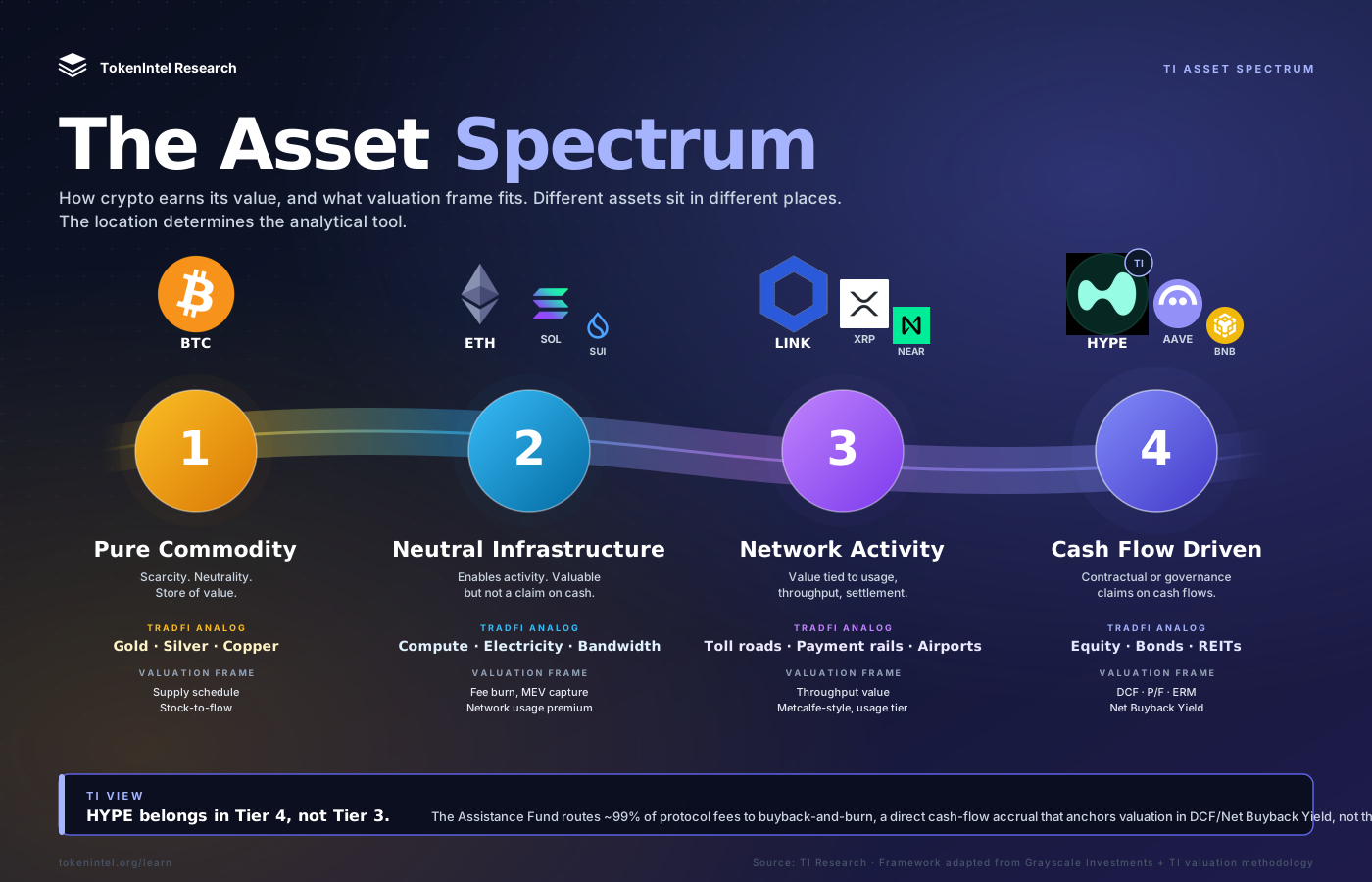
Where an asset sits on this spectrum determines the analytical tool that fits. Kamino earns its value through contractual or governance claims on protocol cash flow, which sets the valuation frame above.
Fundamentals
Q1 2026 Income Statement
| Line | Q1 2026 | Q4 2025 | Q3 2025 | Q2 2025 |
|---|---|---|---|---|
| Total Revenue | $2.59M | $3.85M | $5.83M | $5.14M |
| Net Interest Income | $2.24M | $3.48M | $5.19M | $4.16M |
| Interest Revenue (Gross) | $19.86M | $28.06M | $39.51M | $33.56M |
| Interest Expense (to Depositors) | ($17.62M) | ($24.58M) | ($34.32M) | ($29.4M) |
| Non-Interest Income | $0.35M | $0.37M | $0.64M | $0.99M |
| Liquidation Fees | $0.15M | $0.03M | $0.21M | $0.41M |
| Liquidity Fees | $0.20M | $0.34M | $0.41M | $0.55M |
Source: Kamino Q1 2026 Tokenholder Report by Blockworks Advisory (May 2026), data as of 2026-03-31.
Protocol Metrics (End-Q1 2026)
| Metric | Value | QoQ Change |
|---|---|---|
| Total Deposits | $2.89B | -19% headline (only -$29M / -1% in net flows) |
| Total Outstanding Loans | $1.14B | -6% headline (only -$7.7M / -0.7% in net flows) |
| Loan-to-Deposit Ratio | 39.3% | +5.4 pp (borrowers maintained leverage) |
| Vault AUM | $575.9M | 20% of protocol deposits, +2.4 pp share QoQ |
| Net Interest Margin | 11.3% | -1.1 pp (rate compression) |
| Bad Debt (lifetime) | $0 | Validated through Feb 2026 SOL correction |
| Q1 Liquidations Processed | $41.7M collateral / $41.3M debt repaid | 62.7% concentrated in February's correction |
Net Interest Income Composition (Q1 2026)
- By market category: 18 lending markets generated NII. RWA markets contributed $742.5K (33.2% of total NII), up from 6.5% in Q4 2025. Figure (PRIME mortgage market) was the single largest NII contributor at $567.9K (25.4% of protocol NII), up from $32.2K in Q4 2025. Monthly Figure NII rose consistently January $128.7K → February $198.6K → March $240.6K.
- By asset category: Stablecoins dominated at 65.3% of NII ($1.46M), reflecting persistent stablecoin-borrowing demand across markets. SOL-denominated loans contributed 34.6% ($775K) with LST looping the core use case. The remainder split among composites, liquid staking tokens, foreign L1 assets, and memecoins.
- RWA monthly trajectory: RWA share of monthly NII climbed from 21.3% in January to 36.9% in February to 44.4% in March. Crypto-native NII declined from $685K to $387K over the same window as the Main Market book contracted alongside SOL.
Interest-Rate Environment
End-Q1 2026 stablecoin borrow APY stood at 4.64% (down from 5.26% Q4 end and 7.59% Q3 end), supply APY at 3.16%, narrowing the borrow-supply spread to 148 bps (from 245 bps Q4 end), the tightest in the recent multi-quarter compression. Cross-market spread divergence: Main Market borrow APY fell from 4.81% to 3.58% (-123 bps), while RWA markets held: Figure 6.86% → 6.73% (-13 bps), OnRe 9.90% → 8.18% with rate movements anchored to reinsurance operations rather than crypto sentiment. RWA spreads are anchored to offchain credit markets that set their baseline rates, providing structural insulation from crypto-native rate compression.
Competitive Position
Kamino ended Q1 2026 as Solana's largest lending protocol with $2.89B in deposits and $1.14B in outstanding loans. The Q1 collateral universe (stablecoins, SOL + LSTs, institutional credit, reinsurance, tokenized fund shares, public equities) is the broadest among Solana lending venues and is more diverse than any single Ethereum lending venue currently offers. GLXY became the first NASDAQ-registered public equity listed as onchain collateral on Solana in Q1, introduced through the Superstate Market alongside USCC, CASH, QQQx, SPYx. fBTC was added to the Main Market and USD1 (World Liberty Financial) was onboarded as a new stablecoin collateral type.
Technology
Isolated Multi-Market Architecture
Kamino runs a suite of isolated lending markets, each with its own collateral set, oracle config, LTV ladder, liquidation engine, and risk parameters. Volatility in one market does not propagate to others. End-Q1 2026 the protocol operated 26 isolated markets: Main Market (SOL + LSTs + stables, $1.47B deposits = 50.7% of protocol total), JLP Market, Jito Market, Altcoins Market, plus seven RWA markets (Figure PRIME, Maple, OnRe, Superstate, Huma, xStocks, Apollo) and other satellite markets. The Q1 thesis case for this architecture is that it is precisely what allows tokenized-RWA markets to coexist with crypto-native markets without operationally co-mingling their risk profiles.
Interest Rate Model
Every Kamino market uses a utilization-based interest rate curve. As utilization rises, both Supply APY and Borrow APY rise along a predefined curve with a "kink" at a target utilization, above which rates steepen sharply to attract supply and disincentivize further borrowing. This creates a self-balancing mechanism preventing markets from running out of withdrawable liquidity, while letting RWA markets like Figure (87.9% Q1 utilization) and OnRe (85.5%) operate persistently at high utilization driven by genuine looped-yield borrowing demand.
Loan-to-Value, Liquidation, and the 10% Close Factor
Each collateral asset is assigned a loan-to-value (LTV) ratio capping how much can be borrowed against it, with a higher liquidation threshold above which positions become eligible for liquidation. Kamino's risk infrastructure uses a 10% close factor framework, allowing positions to unwind in controlled increments rather than cascading into forced selling. Validated during the February 5-6 SOL correction: the protocol processed $41.7M in collateral liquidations and $41.3M in debt repaid over the quarter, with $0 bad debt across any market and virtually zero liquidation activity in any RWA market. Borrower behavior through the drawdown was notably stable, leverage was maintained rather than unwound, and the liquidation engine handled the repricing in an orderly fashion rather than through forced deleveraging.
Multiply (One-Click Leveraged Looping)
Multiply is Kamino's one-click leveraged-staking and yield product. Users deposit a yield-bearing asset (JitoSOL, JLP, or RWA-yield tokens like Figure PRIME and OnRe ONyc), and the protocol executes a recursive borrow-and-redeposit loop to amplify exposure. Users see a single position with a target leverage ratio while the protocol manages the underlying loops, oracle updates, and unwinds. Multiply is what drives the persistently high stablecoin utilization that distinguishes Kamino's RWA markets from crypto-native lending: by abstracting the looping flow, the protocol turns "earn levered RWA yield" into a one-click experience for capital that would otherwise not interact with Solana DeFi.
Stable Loops
Stable Loops apply the same looping mechanics to stablecoin strategies. Users supply one stablecoin and borrow another to compound yield differentials and incentive emissions across stablecoin markets without manually executing dozens of transactions.
Oracles and Mark-to-Market
All collateral and debt values on Kamino are marked to market in real time using Solana's onchain price oracles, primarily Pyth and Switchboard. Oracle feeds determine utilization calculations, liquidation eligibility, and interest accrual, making oracle quality a core risk input for every market. Per TI's DeFi risk methodology, oracle update cadence on stress-correlated collateral and operator independence between feeds are explicit scoring criteria; the March 2026 Resolv / Morpho cascade is the canonical case study for why this matters.
BuildKit (Embedded Distribution)
BuildKit is Kamino's developer toolkit allowing external protocols and apps to route deposits into Kamino's lending markets through their own interfaces without building custom smart-contract integrations. RockawayX deployed BuildKit during Q1 to power the Marinade USDC Vault, the first third-party application to embed Kamino yield natively. Privy (fintech wallet infrastructure) began routing fintech app deposits into Kamino vaults during Q1, and OneKey embedded Kamino borrowing directly into its self-custody hardware wallet. The strategic shift this represents: Kamino's credit infrastructure becomes an embedded backend service inside third-party products, expanding the addressable deposit market beyond direct kamino.com users.
RWA Ecosystem & Markets
Kamino's RWA market expansion is the defining structural development of Q1 2026. Total RWA deposits scaled from $570.7M to $1.23B (+115% QoQ), and RWA outstanding loans nearly doubled from $233.7M to $483.1M. Over 40% of Kamino deposits are in RWA markets, up from 15.8% entering the quarter. The Q1 Holder Report frames the protocol as evolving from "the Solana lending venue" to "the infrastructure layer for institutional finance and tokenized assets on Solana."
Live RWA Markets (End-Q1 2026)
| Market | Deposits | Loans | Stablecoin Borrow APY | Notes |
|---|---|---|---|---|
| Figure PRIME (mortgage origination) | $626M | $270.1M | 6.73% | $280M → $626M in Q1; institutional staking backed by BlackRock and Franklin Templeton; 87.9% stablecoin utilization. |
| Maple (institutional credit) | $401M | $147.6M | 3.10% | $240M → $401M in Q1; stablecoin borrow APY moderated as private credit demand softened. |
| OnRe (reinsurance underwriting) | $105M | $34.3M | 8.18% | $29M → $105M in Q1; rate movements tied to reinsurance operations rather than crypto sentiment; 85.5% stablecoin utilization. |
| Superstate | Live | Live | n/a | USCC (tokenized treasury fund shares), CASH, GLXY (first NASDAQ-registered public equity onchain on Solana). |
| xStocks | Live | Live | n/a | QQQx and SPYx synthetic equity products allowing leveraged exposure to US equity indices. |
| Huma | Live | Live | n/a | Onchain receivables / payment-financing market. |
| Apollo | Live | Live | n/a | Tokenized private credit exposure (Apollo Global Management partnership). |
Per Q1 2026 Tokenholder Report (Blockworks Advisory). Live = market live during Q1 2026 with deposits / loans > $0. Last verified: 2026-05-09.
Distribution Beyond DeFi
- Privy (fintech wallet infrastructure) began routing fintech app deposits into Kamino vaults in Q1, creating a pipeline for non-crypto-native capital to access Kamino yield infrastructure through familiar fintech interfaces.
- OneKey (self-custody hardware wallet) embedded Kamino borrowing directly into its wallet experience, enabling hardware wallet users to borrow against holdings without leaving the wallet.
- RockawayX launched its RWA USDC vault during Q1, reaching $14.9M with allocations across four markets, and separately deployed Kamino's BuildKit infrastructure to power the Marinade USDC Vault, the first third-party application to embed Kamino yield natively.
Q2 2026 Institutional Pipeline
Three major institutional-facing products are slated to launch in Q2 2026, each broadening Kamino's addressable deposit base:
- Kamino Institutional Yield: Currently in closed beta. Enables yield from overcollateralized institutional loans.
- Offchain Collateral: Partnership with Solana Company (HSDT) lets borrowers post collateral held at Anchorage Digital Bank and borrow against it onchain. Custodial connection with Anchorage already complete.
- Fixed-Rate Lending: FalconX as pilot borrower. Allows borrowers to lock in fixed interest rates for a fixed period, the primitive making Kamino credit viable for any entity with a planning cycle longer than 24 hours.
- Kamino Private Credit: BTC-backed loans yield available to Kamino depositors. First institutional offchain borrows already funded.
Vaults & Curators
Vaults serve as Kamino's managed-allocation layer where professional curators optimize deposit placement across the protocol's isolated markets. End-Q1 2026 vault deposits stood at $575.9M, down from $626.2M at Q4 end. The contraction was shallower than total protocol deposits (-19%), so vault share of total protocol deposits actually rose from 17.5% to 19.9% over the quarter. Curated positions retained capital more effectively than direct deposits through the Q1 drawdown.
Curator AUM Ranking (End-Q1 2026)
| Curator | End-Q1 AUM | QoQ Change | Notes |
|---|---|---|---|
| Sentora | $399.1M | +38% | Single PYUSD vault; ~$290K weekly PYUSD reward distributions on top of base yield drove blended APY >8%, well above comparable stablecoin vaults. PYUSD share of total vault assets rose from 46.2% to 69.3%. |
| Steakhouse Financial | $69.3M | -62.6% | USDC-denominated vault contraction tracked the broader USDC vault market. |
| Allez Labs | $33.8M | -25.3% | USDC vault contraction. |
| Gauntlet | $27.5M | -69.9% | USDC vault contraction. |
| Elemental | $17.4M | +216% | Fastest-growing curator by percentage; three vaults launched. |
| RockawayX | $14.9M | New (Q1 launch) | RWA USDC vault with allocations across four markets; also deployed BuildKit to power Marinade USDC Vault. |
Sentora's $399M / 69% of vault AUM is concentrated in a single PYUSD vault driven by ~$290K weekly PYUSD reward incentives. If PYUSD incentives end, Sentora's vault deposit base is at risk of rapid migration, and the curator field would re-balance toward USDC vaults that contracted -25% to -70% in Q1. The vault layer's resilience to a Q2 incentive change is the open question.
Governance
Governance Structure
Kamino's governance scope and structure as of May 2026 is described at a high level in the Q1 2026 Tokenholder Report ("KMNO is used for governance, and protocol incentives") but specific detail on voting venue, proposal thresholds, multisig composition, timelock duration, and on-chain execution is best read directly from docs.kamino.finance. Kamino's core development is led by Marius Ciubotariu (Co-Founder) along with the Kamino team.
| Entity | Role | Notes |
|---|---|---|
| KMNO Token Holders | Vote on protocol-level governance proposals | Specific voting venue and proposal threshold per docs.kamino.finance |
| Kamino Core Team | Protocol development, product roadmap, risk parameter proposals | Co-Founder Marius Ciubotariu publicly identified |
| Kamino Vault Curators | Define risk parameters and allocation strategy for individual vaults | Sentora, Steakhouse Financial, Allez Labs, Gauntlet, MEV Capital, Neutral Trade, Elemental, RockawayX, others |
| Risk-Parameter Custodians | Operate the risk-parameter framework for isolated markets and the 10% close-factor liquidation engine | Validated through Feb 2026 SOL correction with $0 bad debt across all markets |
Governance posture caveat: A precise public mapping of who has on-chain admin / pause / parameter-change authority over Kamino's individual markets is not included in the Q1 Tokenholder Report. Per TI's DeFi risk methodology, the Admin Architecture dimension is most accurately scored from the protocol's own contract addresses and timelock configurations rather than secondary materials. Readers wanting that level of detail should pull directly from on-chain inspection or Kamino's docs.
Risk Factors
Risks below are scored in TokenIntel's seven-dimension framework. For the underlying five mechanical risk channels (stress-adjusted coverage, recovery endogeneity, liquidity stress, oracle integrity, execution viability), see the Vault Credit Risk framework. Kamino's $0 lifetime bad-debt record and the Q1 Feb-correction stress test are the primary empirical inputs; the May 2026 AI-era recalibration on the methodology page applies to new / unmaintained markets going forward.
Smart Contract Risk
Medium Risk- Kamino has a multi-year operational track record on Solana with $0 lifetime bad debt, but the codebase is materially larger than minimal-immutable-core designs (Morpho Blue's ~650 lines), which broadens the audit surface.
- Contract security is bolstered by audits and bug-bounty programs per Kamino docs; a complete audit history and bounty-program scope is best verified at docs.kamino.finance.
- Q1 2026 management commentary explicitly cites "investing heavily in security and infrastructure hardening" as a sustained protocol priority.
Oracle Risk
Medium Risk- Kamino markets primarily use Pyth and Switchboard oracles for price feeds. Oracle quality is a core risk input for every market and a known systemic dependency on Solana.
- Per the Q1 Tokenholder Report appendix, "oracle feeds determine utilization calculations, liquidation eligibility, and interest accrual." Stress-correlated collateral (e.g., synthetic stablecoins, NAV-priced assets) requires more conservative update cadence than spot-priced collateral.
- The DeFi Risk Methodology page oracle-latency check (added after the March 2026 Resolv / Morpho cascade) applies here: Kamino's risk-team should be presumed to manage update cadence on RWA collateral classes appropriately, but the operational detail is per-market.
Solana Single-Chain Dependency
Medium Risk- All Kamino deposits, oracle infrastructure, and end-user collateral live on Solana. A network-level outage, validator-set failure, or sustained Solana TVL contraction propagates directly into the protocol.
- Kamino's Q1 2026 deposit base contracted 18.9% headline driven primarily by SOL mark-to-market repricing, not capital outflow. The asset is structurally a leveraged Solana-cycle play even after RWA diversification, and any sustained Solana correction compresses everything at once.
Vault Concentration Risk
Medium Risk- Sentora alone holds $399M / 69% of vault AUM, almost entirely in one PYUSD vault driven by ~$290K weekly PYUSD reward incentives. If PYUSD incentives end, the vault deposit base is at risk of rapid migration.
- Steakhouse, Gauntlet, and Allez Labs USDC vaults contracted -25% to -70% in Q1 2026 as USDC-denominated vault demand softened.
- The vault layer's resilience to a Q2 2026 incentive structure change is the open question.
RWA Counterparty Risk
Medium Risk- RWA market growth depends on offchain counterparties (Figure, Maple, OnRe, Apollo, Superstate) maintaining origination/underwriting demand. Mortgage-rate cycles, private-credit-spread compression, or reinsurance underwriting softness flow through directly.
- RWA outstanding loans are stickier on the deposit side than they appear: Figure and Maple's headline loan growth in Q1 was driven almost entirely by interest-accrual compounding rather than new origination (token-level net flows of $12K and $43K respectively against $147M and $52M headline growth).
- Token Holder Report describes a "10% close factor framework" allowing positions to unwind in controlled increments rather than cascading. Validated through Feb 2026 SOL correction; not yet stress-tested through a major RWA-specific event.
Token Value-Accrual Risk
High Risk- KMNO is currently a governance + protocol-incentive token with no public mechanism explicitly distributing protocol revenue to KMNO holders. Compare to AAVE post-AWW (100% revenue capture under DAO control with $50M/yr buyback program) and SKY (revenue surplus driving SAB and ABC reserves).
- Q1 2026 protocol revenue $2.59M is retained by the protocol; token holder cashflow is contingent on a future governance proposal activating an explicit value-accrual mechanism. Such a mechanism has not been announced.
- Circulating supply ~4.56B / 10B max means future emissions and unlock schedule could absorb a meaningful share of any future capture.
Competition Risk
Medium Risk- Within Solana DeFi: Jupiter Lend ($1.5B TVL via Fluid shared liquidity) is the most credible challenger. Drift, MarginFi successor protocols, Raydium-attached lending, and Solend each compete on different segments.
- Cross-chain: Aave and Morpho on Ethereum-and-L2s collectively dominate DeFi lending and have the deeper RWA partner roster (Apollo on Morpho, Horizon on Aave). Kamino's Solana-native moat does not extend to capital that prefers Ethereum or Base.
- The institutional pipeline (Q2 fixed-rate, offchain collateral, private credit) is the structural answer; if those products do not scale, Kamino's competitive position narrows back to "the Solana lender."
Regulatory Risk
Medium Risk- Kamino RWA markets onboard tokenized institutional products (mortgage origination, institutional credit, reinsurance, public equities) that interact with US securities law in ways the protocol's smart contracts cannot independently police.
- The Anchorage Digital Bank custodial deployment for the Q2 Offchain Collateral product places parts of the user flow within a federally-chartered banking regulatory perimeter. This is a feature for institutional credibility but introduces regulatory dependency.
- SEC staff guidance trajectory in 2026 (non-custodial interfaces clearance) is favorable for the core protocol but neutral-to-negative for distribution layers that integrate Kamino through custodial UIs (Privy fintech routing, OneKey embedded borrow).
Sources & References
Primary Sources
- Kamino.finance. Official Website
- Docs.kamino.finance. Technical Documentation
- Kamino Product Docs (kamino.com/docs)
- Kamino Q1 2026 Tokenholder Report by Blockworks Advisory (May 2026, 30-page primary financial disclosure cited extensively across this page)
Independent Research
- OAK Research, "Kamino V2: a New Standard for On-Chain Credit on Solana and Beyond"
- OneKey, "KMNO Deep Research Report: Token Development and Price Outlook"
Live Market Data
- DefiLlama. Kamino TVL & Protocol Analytics
- DefiLlama. Kamino Lend Fees & Revenue
- CoinGecko. KMNO Market Data
Ecosystem Partner Disclosures
- Figure Technologies. PRIME mortgage origination market (BlackRock + Franklin Templeton institutional staking)
- Maple Finance, institutional credit market
- OnRe, reinsurance underwriting market
- Anchorage Digital Bank. Q2 2026 Offchain Collateral custodial partner
- FalconX. Q2 2026 fixed-rate lending pilot borrower
- Solana Company (HSDT). Q2 2026 Offchain Collateral product partnership
Disclaimer: This research is for informational purposes only and does not constitute financial advice. Cryptocurrency investments carry significant risk. Always conduct your own research and consult with a qualified financial advisor before making investment decisions. The Kamino Q1 2026 Tokenholder Report cited extensively above was funded by StroudGlobal S.A.; per the report's own disclosure, Blockworks Advisory maintained editorial control to retain data accuracy and objectivity. Independent research (OAK, OneKey) was used for cross-reference.
Scoring framework: DeFi Risk Methodology, 6 dimensions, 20 sub-criteria, six structural failure modes.